



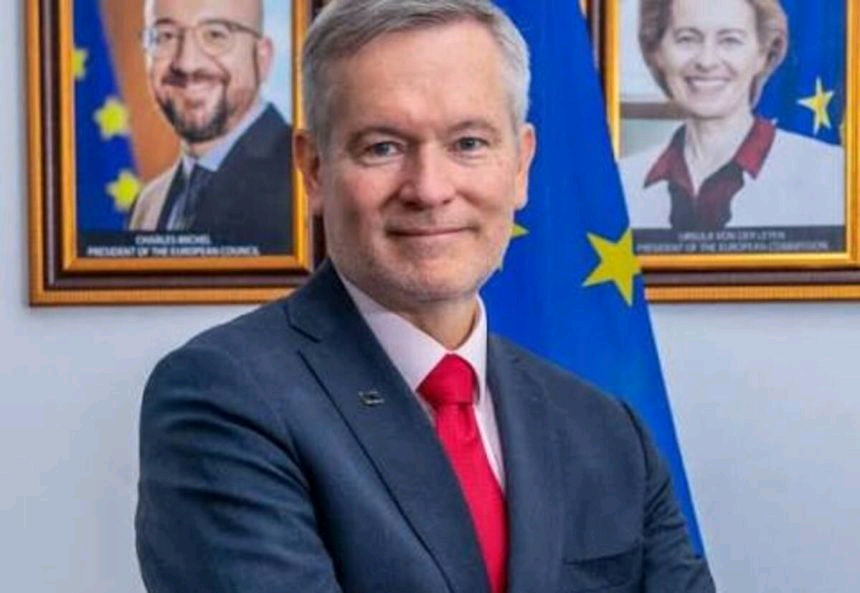

Nigeria’s youthful population, vibrant innovation ecosystem, growing technology sector and expanding digital infrastructure have combined to place the country at the forefront of Africa’s digital transformation, according to the European Union Ambassador to Nigeria and ECOWAS, Gautier Mignot.
Speaking at the opening of the third edition of the Omniverse Africa Summit in Lagos, Mignot said Nigeria possesses the key ingredients needed to drive Africa’s digital and creative future, including a large pool of talented young people, a thriving entrepreneurial culture, increasing investments in technology and a rapidly evolving innovation landscape.
According to the ambassador, these strengths have positioned Nigeria not only as one of Africa’s largest digital markets but also as a country capable of shaping the continent’s future in technology, innovation, artificial intelligence, entrepreneurship and the creative economy.
“The new economy, digital and creative, offers a fantastic opportunity,” Mignot said, stressing that young Nigerians are uniquely positioned to take advantage of emerging opportunities because they belong to a generation that has grown up with digital tools and technologies.
His remarks come at a time when governments, businesses and development partners are increasingly looking to digital innovation as a major driver of economic growth, job creation and competitiveness across Africa.
The Omniverse Africa Summit brought together innovators, entrepreneurs, policymakers, researchers, investors, creatives and development partners from across Africa and beyond to explore how technology, innovation and collaboration can accelerate economic growth, create jobs and unlock new opportunities for millions of young people.
Mignot said the European Union and Nigeria have jointly identified the digital and creative sectors as strategic priorities within their partnership, reflecting the growing importance of technology-driven industries in the country’s development agenda.
He noted that the EU is supporting Nigeria across the entire digital value chain, from policy and governance reforms to infrastructure development, digital skills acquisition, entrepreneurship and innovation.
“In Nigeria, the EU supports the entire digital value chain, from governance to infrastructure, from skills to entrepreneurship,” he said.
To demonstrate that commitment, the ambassador highlighted several ongoing initiatives aimed at strengthening Nigeria’s digital economy and enhancing its competitiveness in the global marketplace.
Among them is a recently signed €45 million agreement between the European Union and Nigeria on digital development, which seeks to support the country’s digital transformation ambitions and expand access to opportunities within the digital economy.
He also cited the European Union’s support for the rollout of 90,000 kilometres of fibre-optic infrastructure across Nigeria, a project expected to improve internet connectivity, expand digital inclusion and create a stronger foundation for innovation and technology-driven businesses.
The ambassador further highlighted the EU’s contribution to Nigeria’s digital public infrastructure agenda as well as support for the Federal Government’s Three Million Technical Talent initiative, which aims to equip millions of Nigerians with digital and technology-related skills needed in the modern economy.
According to him, investments in digital skills are critical to ensuring that young Nigerians are prepared to compete and thrive in an increasingly technology-driven global labour market.
Mignot also pointed to programmes designed to support entrepreneurship, innovation and business growth, including the Digital Transformation Centre Nigeria, which is co-funded by the European Union and the German Government and implemented by GIZ.
The programme supports digital innovation, entrepreneurship and technology adoption among young Nigerians and businesses, helping to bridge gaps between innovation, enterprise development and economic opportunity.
He further highlighted the Nigeria Jubilee Fellows Programme, funded by the European Union and implemented by the United Nations Development Programme in partnership with the Federal Government of Nigeria.
The initiative helps connect young graduates with workplace opportunities, practical experience and professional development pathways, thereby strengthening youth employability and supporting workforce readiness.
Also speaking at the summit, Germany’s Ambassador to Nigeria, Annett Günther, underscored the importance of partnerships and collaboration in shaping the future economy.
“The future will not be built in silos. It will be built through cooperation across sectors, institutions and borders. The future will be connected,” she said.
Günther described Nigeria as home to one of Africa’s most dynamic and rapidly growing innovation ecosystems, noting that Nigerian entrepreneurs are increasingly influencing global trends in sectors such as financial technology, artificial intelligence, agribusiness, healthcare innovation, manufacturing and the creative industries.
According to her, Nigerian innovators are no longer simply responding to global developments but are helping to shape them.
“Nigerian innovators are not simply adapting to global trends. They are shaping them,” she said.
Returning to the significance of the summit, Mignot said one of Omniverse Africa’s greatest strengths lies in its ability to bring together every critical stakeholder within the innovation ecosystem under one roof.
“Policymakers, founders, investors, creatives, researchers, development partners and business leaders are all here, all together,” he said.
He argued that Nigeria’s digital future will depend on stronger collaboration between sectors that have traditionally operated independently.
“Because Nigeria’s digital future will not be built in silos. Technology, creative industries, finance, education, manufacturing, agriculture and public services are no longer separate worlds. They are converging,” the ambassador stated.
Mignot said the summit provides an important platform for transforming conversations into partnerships, ideas into innovation and innovation into practical solutions capable of driving inclusive and sustainable growth.
“The future is connected, but connection must be turned into impact,” he said.
“Let us connect innovators with investors, policy with practice, creativity with technology, and Nigerian talent with global opportunities.”
Discussions at the summit focused on digital transformation, artificial intelligence, entrepreneurship, green technology, future skills, research collaboration and innovation financing, reflecting the growing recognition that technology and innovation will play a central role in Africa’s economic future.
The European Union partnered with Omniverse Africa as part of its broader commitment to promoting innovation, entrepreneurship, digital transformation and youth opportunities in Nigeria and across the continent.
For the EU and its partners, Nigeria’s combination of talent, scale, innovation and ambition makes it one of the continent’s most promising digital frontiers, and a key driver of Africa’s next phase of technological and economic transformation.
