




Africa’s largest refinery runs strong, processing and exporting fuel to West Africa and Europe. Yet nearby, Nigeria’s state refineries lie idle after decades of failure. CHIMA NWOKOJI examines Nigeria’s fuel import paradox and highlights how one private giant, Dangote Refinery, is reshaping African and global fuel trade.
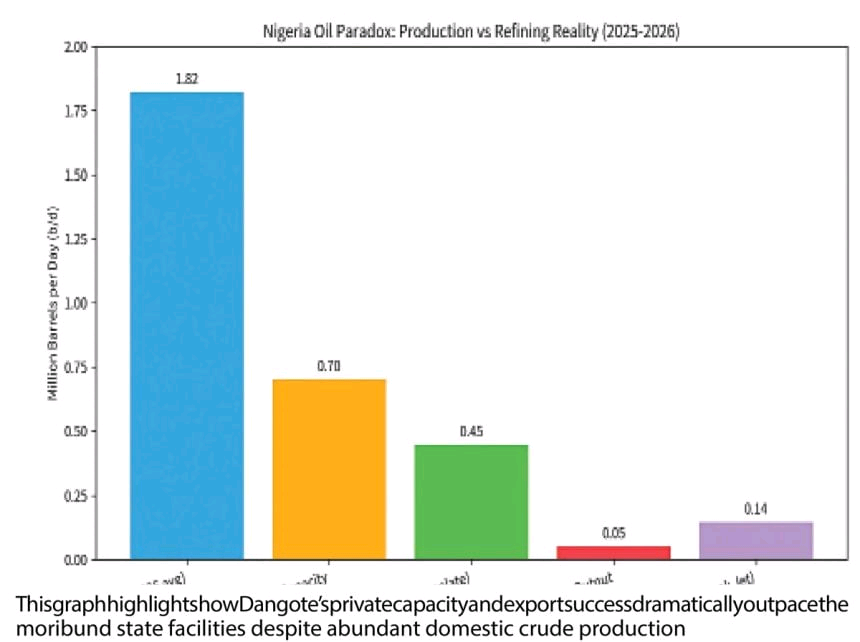
IN the bustling Lekki Free Zone of Lagos, Africa’s largest oil refinery is operating at full throttle. The Dangote Petroleum Refinery, with a processing capacity of up to 700,000 barrels of crude oil per day, is exporting refined petroleum products including jet fuel, diesel and petrol, to markets across West Africa and Europe.
Yet, hundreds of kilometres away, Nigeria’s state-owned refineries in Port Harcourt, Warri and Kaduna remain largely inactive after years of neglect, vandalism, failed rehabilitation efforts and operational inefficiencies.
The contrast between the modern Dangote facility and the decaying government-owned plants encapsulates the paradox at the heart of the country’s petroleum sector in 2026. While one privately funded refinery has become a symbol of industrial ambition and operational efficiency, Nigeria’s public refining assets stand as reminders of decades of policy failures, weak governance and poor maintenance culture.
It is a contradiction that continues to puzzle many observers. Nigeria remains one of the world’s leading crude oil producers, with proven reserves estimated at about 37.5 billion barrels and vast natural gas resources. Yet, the country has historically depended on imported refined products to satisfy domestic demand. Today, however, a single private refinery is changing fuel trade patterns across Africa and increasingly influencing global markets.
Recent data show that the Dangote Petroleum Refinery sourced about 78 percent of its crude oil feedstock from the Nigerian National Petroleum Company Limited (NNPC) and other indigenous producers between May and June 2026.
According to the refinery’s cargo discharge and pricing records for the period, Nigerian crude grades supplied nearly four out of every five barrels processed at the facility, accounting for roughly 78 percent of total feedstock intake. The remaining 22 percent came from imported barrels sourced from Angola, Libya, Ghana, Guyana, and other international blends.
The figures highlight the refinery’s preference for domestic crude while also demonstrating the need to supplement local supply with imports to sustain operations at optimal levels.
Industry analysts say the sourcing pattern reflects the realities of operating a mega-refinery that must maintain uninterrupted production regardless of fluctuations in domestic crude availability.
Commenting on the development, the Chief Executive Officer of the Centre for the Promotion of Private Enterprise (CPPE), Dr Muda Yusuf, described the refinery’s crude procurement strategy as a commercial decision, rather than a political or diplomatic one.
“This is a business decision and the Dangote refinery is a very big refinery. The NNPC cannot meet Dangote’s demands in terms of crude allocation, so it has to source crude from elsewhere that is commercially competitive. If the quality standard is good and the price is good, why not? It is purely a business decision; it is not a diplomatic thing,” Yusuf said.
He noted that as Nigeria expands refining capacity, competition for crude oil feedstock will naturally intensify.
“If more refineries are built in Nigeria, the crude produced in Nigeria may not even be enough for all of them. That is healthy competition. Before now, we depended on imported petroleum products, but today we have choices. We have our own refinery that can buy crude from the UAE, America or elsewhere. The government should ensure national interest is protected while allowing businesses to make sound commercial decisions,” he added.
Yusuf also argued that increased petroleum trade could strengthen economic ties between Nigeria and other countries, particularly the United Arab Emirates.
“If you have more trade, it is good for relationships between countries. The primary thing is the business consideration, but the fact that you are having more trade is also good for our relationship, especially now that Nigeria and the UAE have signed a trade protocol,” he said.
According to him, the refinery’s procurement pattern also reinforces concerns previously raised by domestic refiners over limited access to local crude supplies.
“Local crude has accounted for only about 30 percent of Dangote Refinery’s feedstock from the beginning because domestic availability is not meeting demand. There are joint venture arrangements, previous forward sales, and commercial terms that make it necessary to buy elsewhere. If the terms offered locally are not favourable, the refinery has to source crude abroad,” he said.
The comments underscore the commercial realities of Nigeria’s oil industry, where contractual obligations, legacy financing arrangements and pricing considerations often influence crude allocation decisions.
Despite these challenges, the refinery has continued to expand production and exports. Data from S&P Global Commodity Insights show that the Dangote Refinery exported about 466,000 metric tonnes of jet fuel to Europe in June 2026, with an estimated value of approximately N757 billion.
The volume represented a significant increase from the 232,000 metric tonnes exported in May and marked the highest level of Nigerian jet fuel exports to Europe since the country became a net exporter of aviation fuel in 2024 following the commencement of Dangote’s jet fuel production.
The increase came as disruptions in global fuel markets created opportunities for new suppliers. Analysts say the refinery successfully leveraged its competitive pricing structure and reliable output to gain market share in Europe.
S&P Global Commodity Insights noted that the exports occurred at a time when the European jet fuel market was turning increasingly bearish after prices retreated from highs triggered by tensions in the Middle East.
Additional data from the Nigerian Midstream and Downstream Petroleum Regulatory Authority (NMDPRA) showed that the refinery exported an estimated 1.66 billion litres of refined petroleum products in April 2026.
The exports included approximately 513 million litres of Premium Motor Spirit (PMS), 534 million litres of Automotive Gas Oil (diesel) and 615 million litres of aviation fuel.
The figures illustrate the refinery’s ability to produce a broad range of petroleum products while serving multiple export markets simultaneously.
Since commercial operations began in 2024, the Dangote Refinery has rapidly evolved into one of the most influential refining facilities in the world. The project, which reportedly cost more than $20 billion to build, achieved record operating levels during May and June 2026.
Industry estimates indicate that the refinery has reduced West Africa’s dependence on imported fuel from outside the region by approximately 25 per cent. It has also displaced some supplies from traditional exporters in the Gulf region and the United States.
The refinery’s flexibility in processing different crude grades and its relatively low operating costs have enabled it to sustain exports of as much as 145,000 barrels per day of jet fuel, much of which is shipped to the Amsterdam-Rotterdam-Antwerp (ARA) trading hub in Europe. It also supplies diesel and other refined products to neighbouring African countries.
Energy analyst Natalia Katona of Oilprice.com summed up the impact succinctly when she observed that, “Dangote’s rise has already reshaped the West African fuel trade.”
The phenomenon increasingly described by industry observers as the “Dangote Effect” highlights a striking contradiction. While Nigerians continue to grapple with fuel affordability concerns, distribution bottlenecks and supply challenges at home, a privately owned refinery is emerging as a major force in regional and international fuel markets.
Dead refineries: Years of broken promises
Nigeria’s government-owned refineries have a combined installed capacity of 445,000 barrels per day. Yet, for years they have contributed little to domestic fuel supply.
The Port Harcourt Refining Company, with a nameplate capacity of 210,000 barrels per day, effectively ceased meaningful operations years ago and was fully shut down in 2019. The Warri refinery, with a capacity of 125,000 barrels per day, and the Kaduna refinery have experienced similar operational decline.
Successive governments have spent billions of dollars attempting to rehabilitate these facilities. Recent estimates suggest that nearly $3 billion has been committed to refinery rehabilitation projects, yet production results remain disappointing.
Repeated promises of turnaround maintenance have been followed by missed deadlines, cost overruns and allegations of mismanagement, eroding public confidence in government-led refinery revival efforts.
Fresh attempts to attract foreign partners, including Chinese firms such as Sanjiang Chemical and Xingcheng Industrial Park, have generated scepticism among industry experts. Critics argue that the companies have limited experience operating large and ageing crude oil refineries such as those in Nigeria.
Energy analyst, Kelvin Emmanuel, has repeatedly argued that the facilities, some of which are more than six decades old, may require complete reconstruction rather than incremental repairs.
Concerns over accountability have further complicated matters. The Economic and Financial Crimes Commission (EFCC) has questioned former NNPC officials over the utilisation of funds allocated for refinery rehabilitation.
Former NNPC Group Chief Executive Officer, Mele Kyari, has also been directed by the Senate to explain disputed financial records reportedly valued at about N210 trillion. The NNPC has maintained that the figures represent legitimate commercial transactions and accounting entries rather than missing funds.
For many observers, the investigations reflect longstanding governance challenges that continue to undermine efforts to restore the refineries.
Minister of State for Petroleum Resources (Oil), Heineken Lokpobiri, has acknowledged the scale of the challenges inherited by the current administration. According to him, crude oil production was below one million barrels per day when President Bola Tinubu assumed office in 2023 but has since risen to approximately 1.82 million barrels per day.
While the improvement is significant, domestic refining still faces constraints because large portions of crude production are allocated to debt servicing arrangements, exports and losses linked to theft.
Nigeria currently commits about 213,000 barrels per day to crude-backed financing arrangements under programmes such as Project Gazelle, Yield, Leopard and Eagle Export Funding. In 2025, roughly 14.66 percent of national oil production was reportedly used for debt repayment obligations.
Dangote’s success and local supply challenges
The Dangote Refinery itself has not been immune to these structural constraints. Although the refinery relies heavily on Nigerian crude grades such as Bonny Light, Escravos and Forcados, it also imports crude from the United States, Libya, Cameroon, Ghana, the UAE and Guyana to maintain stable production.
Between May and June 2026, the refinery imported about 40.40 million barrels of crude oil valued at approximately $4.48 billion. During the period, average crude acquisition costs declined from $124.80 per barrel in May to $95.25 per barrel in June due to softer global prices and more efficient feedstock blending.
Industry sources say NNPC had committed to supplying between 13 and 15 crude cargoes monthly to the refinery but frequently delivered fewer volumes, sometimes as low as five cargoes.
The supply shortfall has contributed to legal disputes between Dangote Refinery and regulatory authorities over the issuance of fuel import licences to NNPC and independent marketers, including NIPCO and AA Rano.
Dangote argues that its refining capacity exceeds 650,000 barrels per day and is sufficient to meet Nigeria’s fuel requirements in line with the Petroleum Industry Act. The case, scheduled for hearing in October 2026, is expected to address broader questions about local refining priorities and the continued role of imports in ensuring energy security.
Despite these challenges, the refinery has continued to expand output. Operational improvements recently increased processing capacity to 700,000 barrels per day, while optimised crude blending has enhanced production yields for petrol and diesel.
Its ability to increase exports during periods of geopolitical uncertainty, including disruptions linked to tensions between the United States and Iran, has further strengthened its position as a reliable supplier to international markets.
Changing global trade and future opportunities
Beyond Nigeria, the refinery is increasingly reshaping global fuel flows. By June 2026, nearly half of Dangote’s export cargoes consisted of jet fuel destined for Europe’s ARA hub, directly challenging established suppliers from Kuwait, India and the United States.
Its diesel exports have also reduced West Africa’s dependence on imports from Belgium, the Netherlands, Spain, India and Russia.
Industry experts believe the refinery’s integrated structure; modern technology and logistics advantages provide a cost edge that allows it to remain competitive even during periods of weaker global demand.
Looking ahead, Dangote Group plans to expand refining capacity further. Proposals have been outlined for an additional 750,000-barrel-per-day refining unit that could increase total capacity to 1.45 million barrels per day by 2028.
If realised, the facility could surpass India’s Reliance refinery complex and become the world’s largest refinery.
The group is also pursuing ambitious expansion plans beyond Nigeria. Among them is a proposed 700,000-barrel-per-day refinery in Lamu, Kenya, estimated to cost about $17 billion.
The project is expected to be financed through a combination of internal funding, bond issuance and a future public offering. Tanzanian businessman Mohammed Dewji has already expressed interest in investing $100 million in the venture.
Additional plans include a 1.6-million-barrel storage terminal in Walvis Bay, Namibia, which would supply fuel to Botswana, Zimbabwe, Zambia and parts of South Africa.
According to Dangote Industries Vice President for Oil and Gas, Edwin Devakumar, location selection has been guided by logistics efficiency and proximity to key markets.
Problems and the Way Ahead
Despite the optimism, significant hurdles remain. Infrastructure deficits, security concerns, currency volatility and regulatory uncertainty continue to pose risks to expansion plans.
Within Nigeria, petroleum product distribution still relies heavily on road transportation because of persistent concerns about pipeline vandalism.
Legal disputes involving NNPC and market regulators also create uncertainty for investors.
Nevertheless, many industry stakeholders remain hopeful. Dr. Yusuf believes reforms within NNPC are gradually improving commercial discipline.
In a significant policy shift, NNPC recently announced that future funding for the Port Harcourt and Warri refineries would no longer rely on crude-backed financing arrangements. Instead, financing would depend on operational performance and the ability of the refineries to attract investment independently.
Economist Dr. Aliyu Ilias has called for greater transparency in crude allocation and trading arrangements, while Ademola Adigun of AHA Strategies advocates stronger oversight of crude-backed agreements to maximise value for the country.
Nigeria possesses the resources, legislation and market potential to become a major refining hub. The Petroleum Industry Act, ongoing oil block licensing rounds and abundant hydrocarbon reserves provide a foundation for growth.
The contrast between Nigeria’s struggling public refineries and the success of the Dangote Refinery captures the central challenge facing the country’s petroleum industry. One reflects decades of missed opportunities; the other demonstrates what private capital, long-term vision and operational efficiency can achieve.
As production rises and global energy markets search for alternative suppliers, Dangote’s planned expansion to 1.45 million barrels per day, combined with its pan-African ambitions, could usher in a new era for refining on the continent.
For Nigeria, the task is clear: ensure reliable crude supply, improve transparency, reduce inefficiencies and create a business environment where local refining can flourish.
If those conditions are met, the country could finally transform its long-standing fuel paradox into a success story—one that powers homes, industries and economic growth across Africa and beyond.
More than a refinery, Aliko Dangote’s project has become a symbol of Africa’s capacity to shape its own energy future. In an era of shifting alliances, supply disruptions and growing demand for energy security, that vision is becoming increasingly relevant—not only for Nigeria, but for two continents.
