



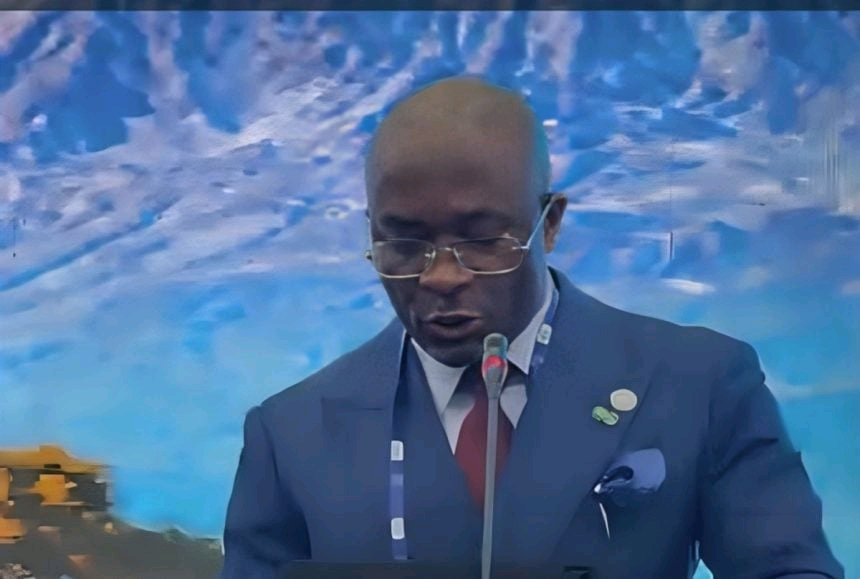

…says Nigeria requires $500bn capital investment to achieve net zero emission by 2060
Deputy Speaker of Nigeria’s House of Representatives, Hon. Benjamin Kalu, on Thursday proposed structured legislative interventions across the globe as an urgent parliamentary action to address climate-related disasters and strengthen resilience in vulnerable regions.
Speaking during a debate on “Urgent Parliamentary Action to Address Climate-Related Disasters and Strengthen Resilience” at the ongoing 153rd Assembly of the Inter-Parliamentary Union (IPU) in Arusha, Tanzania, Hon. Kalu said the debate must move beyond pledges to practical, bankable legislative actions that deliver for people and economies.
He said the structured global legislative intervention should, however, be built on two pillars: an investor-ready pipeline of priority projects across clean energy, transport, agriculture, resilient infrastructure and the circular economy; and a project-preparation and transaction-support platform that helps move viable projects from concept to bankability, financing and implementation.
The Deputy Speaker urged lawmakers to see themselves as architects of the legal certainty and public accountability required for a resilient, competitive and sustainable economy, combining sound legislation, credible institutions, sub-national innovation and international capital to transform the goals of the Paris Agreement into practical progress.
He said: “Across the globe, farmers are confronting irregular rainfall and declining yields; coastal communities are facing erosion and rising waters; businesses are losing productive hours to unreliable energy; and cities are struggling with flooding that overwhelms drainage systems and infrastructure.
“Our people are already living with the consequences of extreme weather, flooding, land degradation, food insecurity and climate-related displacement. Climate finance must therefore support both emissions reduction and human resilience. As legislators, we should understand that legislation must not remain a statement of intent. It must become an instrument of delivery.
“Lawmakers are not just observers of the climate crisis, but architects of the legal certainty and public accountability required for a resilient, competitive and sustainable economy. Today, I propose that this debate should not end as another important conversation. It should become the beginning of a structured legislative intervention across the globe. First, it should support the development of an investor-ready pipeline of priority projects across clean energy, transport, agriculture, resilient infrastructure and the circular economy.
“Second, it should establish a project-preparation and transaction-support platform that helps move viable projects from concept to bankability, financing and implementation. This is how ambition becomes action. This is how policy becomes finance. And this is how finance becomes infrastructure, jobs, resilience and shared prosperity.
“Distinguished colleagues, we can combine sound legislation, credible institutions, sub-national innovation and international capital to transform the goals of the Paris Agreement into practical progress for the people of Nigeria and other developing countries.”
While noting that climate action is not an abstract environmental aspiration but a livelihood and economic issue in Nigeria, he maintained that “for Nigeria, climate action is not an abstract environmental aspiration, but about whether a farmer can harvest despite changing rainfall patterns; whether a family can access affordable and reliable electricity; whether a young person can find dignified work in a modern economy; whether our cities can withstand floods; and whether Africa’s largest economy can industrialise without reproducing the environmental vulnerabilities of the past.”
Hon. Kalu, however, lamented delays in the implementation of agreements, saying that for too long, the international climate dialogue had been defined by ambitious pledges that had not been matched by adequate, accessible and affordable finance for developing countries.
Stressing that Nigeria was not at the Assembly merely to restate its needs but to present an opportunity, he beckoned on foreign investors to co-finance a growing pipeline of commercially viable, climate-resilient projects supported by law, public policy, accountable institutions and a legislature committed to delivery.
The Deputy Speaker recalled that at COP26, Nigeria announced its commitment to achieve net-zero emissions by 2060 through the Nigeria Energy Transition Plan, describing it as a development-centred pathway that seeks not only to reduce emissions but also to expand energy access, reduce poverty, create jobs and build a more resilient economy.
Hon. Kalu revealed that the scale of the opportunity was substantial, noting that Nigeria’s updated Energy Transition Plan estimates that approximately US$500 billion in capital investment above business-as-usual spending will be required to achieve net zero by 2060.
“This is not simply a financing gap; it is an investment horizon. It is an opportunity to build new markets, modernise infrastructure, create green jobs, unlock innovation and deliver long-term returns,” he said.
The Deputy Speaker also listed priority investment areas to include distributed renewable energy, solar mini-grids, battery storage, clean cooking solutions, electricity transmission and distribution infrastructure, industrial energy efficiency, climate-smart agriculture, irrigation, cold-chain logistics, food processing, electric mobility, mass transit, low-carbon urban transport, waste-to-value systems, methane reduction and green manufacturing.
He stressed adaptation investments, including flood-control systems, resilient drainage, coastal protection, nature-based solutions, climate-resilient housing and infrastructure.
Hon. Kalu insisted that climate finance must support both mitigation and adaptation, as developing nations are already living with extreme weather, flooding, land degradation, food insecurity and climate-related displacement.
He listed Nigeria’s legislative commitments to include strengthening implementation of the Climate Change Act, monitoring climate-related public expenditure, supporting credible carbon-market and green-finance frameworks, promoting reforms that improve investor protection and contract enforcement, ensuring transparent approval processes for green projects, supporting the expansion of state-level electricity markets, and convening sustained dialogue among government, investors and communities.
“Our message is simple: Nigeria’s green transition must be a just transition. It must expand access to affordable energy, create decent work, support communities, equip young people with new skills, promote women’s participation in the green economy and ensure that no region or social group is left behind,” Hon. Kalu said.t no region or social group is left behind,” Hon. Kalu said.
