



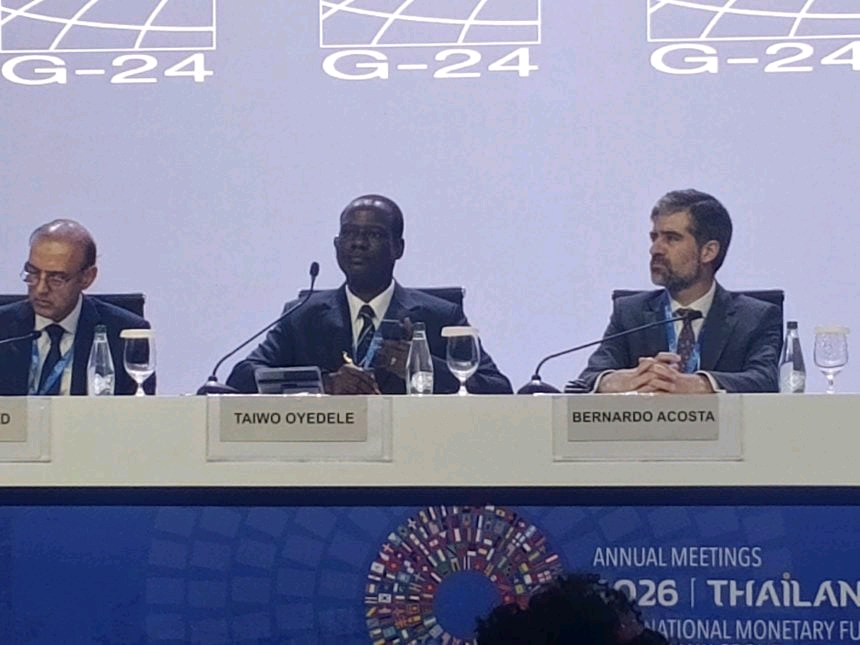

Nigeria’s Minister of Finance and Coordinating Minister of the Economy, Taiwo Oyedele, has said borrowing and debt financing remain necessary conditions for economic growth, urging developing countries to deploy loans productively in order to stimulate job creation and inclusive development.
Oyedele, who currently chairs the Intergovernmental Group of Twenty-Four (G-24), made the remarks on the sidelines of the 2026 World Bank/International Monetary Fund Annual Meetings in Bangkok, Thailand.
There, the group pressed for expanded affordable financing for emerging markets and developing economies confronting rising debt-service costs and constrained fiscal space.
Reading the group’s communiqué, he noted that developing countries, particularly those in Africa, are struggling under the dual burden of elevated debt stocks and expensive borrowing. Some estimates indicate they pay roughly $500 billion more in debt-related costs than their developed counterparts.
Governments, he said, must strengthen domestic revenue mobilisation and identify efficiency savings while carefully avoiding additional tax burdens on vulnerable households and the productive sectors of their economies.
“Our charge to both the IMF and the World Bank is to find means of making, particularly in the short term, more affordable concessional borrowing available to vulnerable countries,” Oyedele stated. He added that multilateral institutions should design longer-term frameworks and policies capable of mobilising private capital, thereby freeing scarce public resources for essential social services.
The minister cautioned that debt management and taxation must always be approached with the welfare of citizens in mind. Excessive debt obligations, he warned, can deprive governments of the resources required to deliver food security, healthcare and education. “Debt is future taxes,” he emphasised, underscoring the need for a careful balance between borrowing and revenue generation to secure sustainable development.
In its 2026 annual meeting communiqué, the G-24 observed that geopolitical conflicts, shifting trade policies, monetary-policy uncertainty, volatile commodity prices and increasingly frequent climate shocks are generating significant headwinds for global growth. These forces, the group warned, threaten the ability of emerging and developing economies to achieve inclusive, job-rich economic transformation.
The G-24 therefore called for a stronger global financial safety net anchored by a well-resourced, quota-based IMF, together with governance reforms that better reflect the evolving weight of emerging markets while safeguarding the voice of smaller and poorer members. It urged the fund to ensure its lending programmes support growth, protect social spending and public investment, and avoid excessively front-loaded adjustment that could undermine recovery.
On debt sustainability, the group advocated predictable, timely and coordinated sovereign debt treatments, greater transparency and improved credit-risk assessments. It welcomed the World Bank’s Growth 2030 strategic roadmap and called for deeper collaboration among multilateral, regional and national development institutions to strengthen domestic markets and scale innovative financing instruments.
Oyedele further cautioned that the rapid adoption of artificial intelligence without appropriate policies and regulation risks generating growth that fails to create sufficient employment, especially in countries with large youth populations. Economic expansion, he insisted, must translate into jobs, inclusion and higher living standards rather than being pursued as an end in itself.
The G-24 also pressed for stronger international cooperation on climate finance, urging the World Bank Group, regional development banks and other stakeholders to deliver at least $300 billion annually in climate finance by 2035. On international taxation, the group called for concerted measures to curb profit shifting, tax avoidance and illicit financial flows.
The G-24 is a coalition of developing countries that coordinates positions on monetary and development-finance issues at the IMF and World Bank. Its ministerial meetings take place twice yearly alongside the institutions’ Spring and Annual Meetings.
