



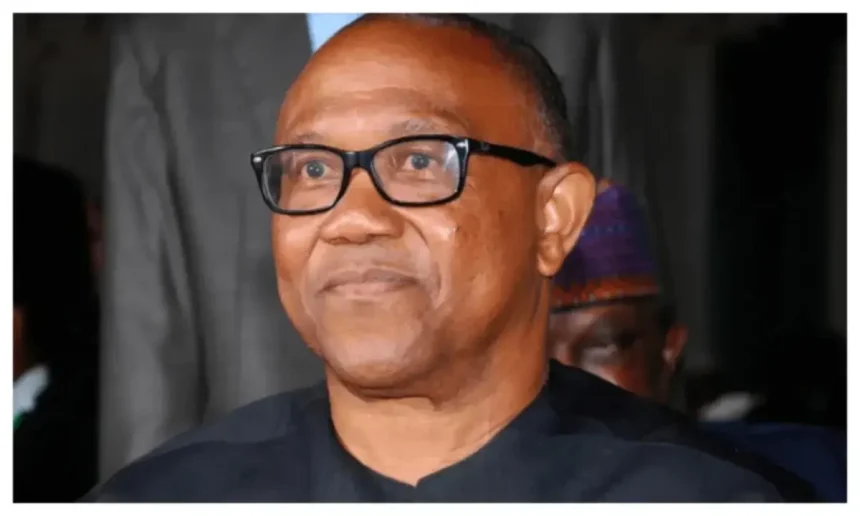

Presidential candidate of the Nigeria Democratic Congress (NDC), Peter Obi, has rejected claims that he left Anambra with $123.77 million in external debt when he handed over power in March 2014, saying the figure represents a combination of different development-financing categories rather than conventional loans personally obtained by his administration.
Obi, who spoke against the backdrop of an ongoing dispute between him and the Anambra State Government over the state’s debt profile, said he had remained silent in recent days because of the death of his elder brother and friend, Chief Okey Ezeibe.
The former governor said he had no disagreement with Governor Chukwuma Soludo or any other governor, adding that his focus remained on what he described as the challenges confronting Nigerians.
The Anambra State Government had recently released figures which it said were based on Debt Management Office records, stating that eight external loan facilities associated with Obi’s tenure had a combined original value of $123.77 million, with $92.35 million still outstanding as of June 30, 2026.
However, Obi disputed the characterisation of the facilities as “debt owed by Peter Obi”, arguing that most were development-support programmes negotiated by the Federal Government and accessed by participating states through subsidiary arrangements.
He said, “As Governor of Anambra State, I did not approach any financial institution to borrow funds or issue a bond on behalf of the state.”
Obi recalled that at his farewell ceremony, the then Director-General of the Debt Management Office, Abraham Nwankwo, had described him as the only state governor during his 10-year tenure who did not approach him for a loan facility.
He also maintained that when he left office on March 17, 2014, the state had no unpaid salaries, gratuities or pensions, and did not owe contractors or suppliers whose completed works had been verified and certified.
On the World Bank-related financing, Obi said the facilities were concessionary development-support funds secured by the Federal Government for states selected to address specific development needs, with repayment spread over 25 to 30 years.
He argued that the state government should distinguish between the total amount approved for a multi-year development programme, the amount actually drawn during his tenure, and the outstanding balance at the time he handed over.
According to him, combining those figures and describing the resulting $123.77 million as “loans left by Peter Obi” amounted to an incorrect application of public-sector accounting.
He said the eight facilities cited by the state government were primarily World Bank and International Fund for Agricultural Development (IFAD) development programmes covering areas such as health, education, agriculture and erosion control.
“This does not suggest that Anambra had no repayment responsibilities; rather, each facility must be examined in light of its approval, effectiveness, drawdown, and repayment record,” he said.
Obi also questioned the figures attributed to the state’s external debt at different periods, saying records available to him showed Anambra’s external debt at about $18 million when he assumed office in March 2006 and approximately $30 million when he left office in March 2014.
He further cited a figure of about $45.15 million as of December 2014, nine months after his departure, and questioned how the state could have inherited $123.77 million from his administration if its recorded external debt was about $30 million when he handed over.
The former governor also maintained that he left more than $150 million as the dollar component of his investment in the state, saying the funds were expected to generate about $10 million annually.
He argued that, even if the state government’s debt figure were accepted, the returns from the funds he said he left behind could have been used over the years to offset the liability.
Obi said that, based on his calculations, retaining the funds and their accumulated returns could have resulted in about $335 million by now, although the figures remain part of his own account of the state’s finances.
The Anambra State Government, however, has maintained that the $123.77 million figure represents eight external borrowings contracted during Obi’s administration and that $92.35 million remained outstanding as of June 2026. It said successive administrations had continued to service the facilities.
Obi said he would not engage in a prolonged exchange of words over his tenure in Anambra, adding that his attention would remain on issues affecting Nigerians.
“My focus will now be on issues affecting the suffering Nigerian masses, which is the reason for my presidential ambition,” he said.
