



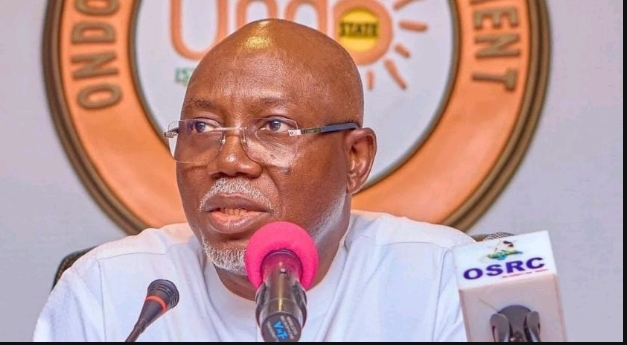

Ondo State Governor, Lucky Aiyedatiwa, on Friday declared that the state is fully prepared for the establishment of state police, as former Edo State Governor Adams Oshiomhole and elder statesman Olu Falae called for a comprehensive overhaul of Nigeria’s security architecture to strengthen democracy and national stability.
The trio spoke at the 33rd anniversary lecture commemorating the annulled June 12, 1993, presidential election, held at the International Centre for Culture and Events (The Dome), Akure.
The event brought together political leaders, traditional rulers, government officials, civil society groups, youths, and security agencies to reflect on Nigeria’s democratic journey and the challenges confronting the nation.
Aiyedatiwa described June 12 as a defining moment in Nigeria’s history and a lasting symbol of credible elections, accountability, and the supremacy of the people’s will.
According to him, democracy remains a work in progress that requires strong institutions, adherence to the rule of law, and active citizen participation.
He warned that insecurity poses a serious threat to democratic governance, noting that violence, fear, and instability undermine public confidence in government and discourage civic engagement.
“Democracy cannot flourish where citizens live in fear. Security is the foundation upon which development and democratic governance thrive,” he said.
The governor commended President Bola Tinubu’s efforts to improve national security through enhanced coordination among security agencies and stressed that Ondo State would continue to complement federal initiatives through its own security programmes.
Highlighting measures taken under his administration, Aiyedatiwa said the state had strengthened the Amotekun Corps through improved welfare packages, enrolment in the Contributory Pension Scheme, medical allowances, and the recruitment of 500 additional personnel.
He expressed sympathy for victims of recent attacks and kidnappings across the country and called for collective action to tackle insecurity.
On the agitation for state police, Aiyedatiwa said Ondo State already has the institutional framework required to operate the system.
“For us in Ondo State, we have been ready for a long time. The structure established during the administration of my predecessor, Arakunrin Oluwarotimi Akeredolu, has been strengthened.
“We have the personnel and the framework in place. What remains is approval for the necessary weapons and equipment to make the outfit more effective,” he said.
Delivering the anniversary lecture, Oshiomhole described June 12 as a powerful symbol of courage, sacrifice, and democratic conviction, embodied by the late Chief MKO Abiola.
He said Abiola’s refusal to surrender the mandate freely given to him by Nigerians, despite pressure from successive military regimes, elevated him into a global symbol of democratic resistance.
“In celebrating Abiola, we are celebrating courage, consistency, commitment to nationhood, and fearlessness. He stood firm for democracy and he stood firm for Nigeria,” Oshiomhole said.
The former labour leader recalled his involvement in the pro-democracy struggle and praised Falae’s contributions during negotiations between labour unions and military authorities.
He noted that the June 12 election demonstrated an uncommon level of national unity, with Nigerians voting beyond ethnic and religious considerations.
Oshiomhole, however, expressed concern over the increasing influence of religious sentiments in politics.
“Talking about June 12 is to remind ourselves that we once had leaders who commanded respect across the North, South, East, and West. Religion has become an issue in a way that distorts political understanding,” he said.
He also defended the National Assembly’s ongoing scrutiny of the audited accounts of the Nigerian National Petroleum Company Limited (NNPCL), insisting that legislative oversight should not be mistaken for hostility towards the government.
According to him, democracy thrives when public institutions are held accountable.
Oshiomhole further endorsed President Tinubu’s economic reforms, including fuel subsidy removal and exchange-rate unification.
He argued that the subsidy regime had become a major source of corruption and economic distortions.
He also advocated the reintroduction of History as a core subject in schools, saying younger generations must understand the nation’s past in order to build a better future.
Speaking earlier, Falae described June 12 as a watershed in Nigeria’s political development and recalled the sacrifices made by pro-democracy activists following the annulment of the presidential election won by Abiola.
He said the annulment triggered widespread resistance, leading to the emergence of the National Democratic Coalition (NADECO) and a sustained campaign against military rule.
According to him, many activists suffered detention, exile, and persecution during the struggle.
“We paid a huge price for democracy. Many were imprisoned, some went into exile, and others lost their lives. Those sacrifices must never be forgotten,” Falae said.
He warned against any return to military rule, stressing that democratic governance, despite its imperfections, remains the best system for national development and citizens’ participation.
In his welcome address, the Chief of Staff to the Governor, Prince Segun Omojuwa, described June 12 as a symbol of hope, unity, and the triumph of the people’s will.
He urged Nigerians to remain committed to democratic values and
work collectively to address insecurity, institutional distrust, and voter apathy.
