




When, at dawn on Sunday, June 21, the Independent National Electoral Commission (INEC) announced Governor Biodun Oyebanji of Ekiti State as the winner of the election it conducted in the state on June 20, the reaction from many quarters was that of “we said so.” President Bola Ahmed Tinubu said that the victory represented “a clear vote of confidence in continuity, stability and people-centred governance”, while the leadership of the ruling All Progressives Congress (APC) described the victory as a loud demonstration of the confidence of Ekiti people in Oyebanji. The governor himself attributed the outcome to a validation of Tinubu’s government. In all, none of the sources, whether from the side of the voters or the political stakeholders, expressed surprise at the resounding victory recorded by Oyebanji.
While the off-season election has been won and lost, the predictability of Governor Biodun Oyebanji’s victory has also entered the record books. The victory, according to sources, rested on strong pillars, faces, factors, and forces, which made the contest a walk in the park for Oyebanji and the APC.
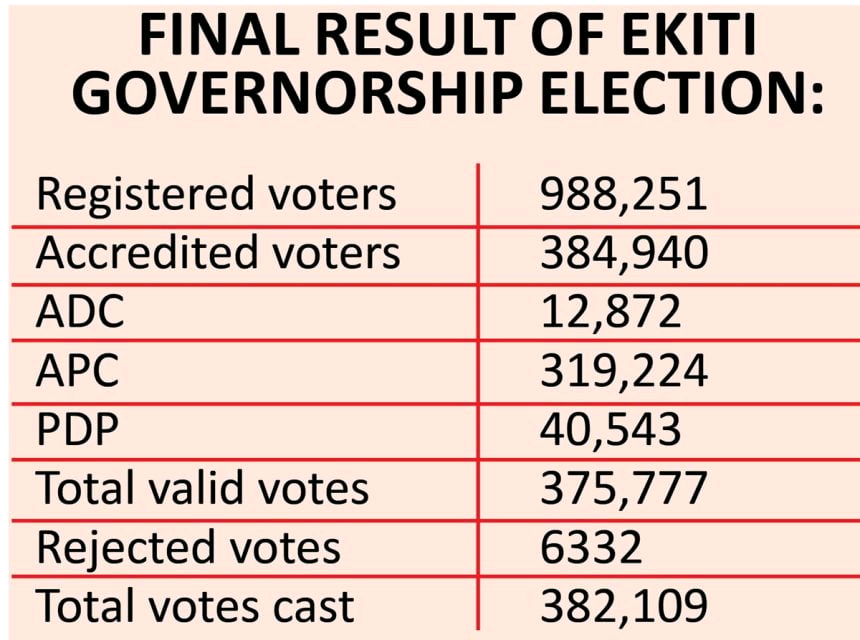
In the early hours of Sunday, June 21, the Independent National Electoral Commission (INEC) announced Governor Biodun Oyebanji of Ekiti State as the winner of the off-season election in the state. According to INEC, the incumbent Ekiti governor, who is of the All Progressives Congress (APC), polled 319,224 votes to beat his distant challenger, Wole Oluyede of the Peoples Democratic Party (PDP), who won 40,543 votes, while the candidate of the African Democratic Congress (ADC), Dare Bejide, polled 12,872 votes. INEC said that Oyebanji was declared the winner after emerging victorious in all of the 16 local governments that make up the state. According to the Electoral Commission, the APC candidate met the constitutional requirements and the laws that guaranteed his being declared the winner. The body stated that a total of 6,332 votes were rejected, out of 382,109 votes cast. The election recorded a total of 384,940 voters out of a total of 988,251 registered voters across the state.
Oyebanji beats the re-election jinx
Oyebanji, in winning the election, made history as the first Ekiti State governor to win a back-to-back victory in the state. Though he won in all of the 16 local governments, to repeat the feat first recorded by Governor Ayo Fayose in 2014, he surpassed the records of all his predecessors by being the first governor to succeed himself. Fayose failed to get that done in 2007, and Dr. Kayode Fayemi, who handed over to Oyebanji in 2022, equally failed to attain that feat in 2014. Before the duo, Chief Niyi Adebayo, the first civilian governor of the state in the Fourth Republic, lost his re-election bid to Fayose in 2003. So, for Ekiti, it’s been a game of musical chairs sort of, with five men exchanging batons among themselves in the 27 years of the Fourth Republic politics. It moved from Niyi Adebayo in 2003 to Ayo Fayose. Fayose was impeached before the end of his tenure, and in 2007, Engineer Segun Oni took charge. He was, however, removed through a bye-election which was ordered in 2010 by the Court of Appeal, sitting in Ilorin, Kwara State. The court had nullified some votes and ordered a rerun. Oni did not make it through the rerun, and Dr. Kayode Fayemi took charge in 2010. From Fayemi, it moved back to Fayose in 2014 and then to Fayemi in 2018, following which Biodun Oyebanji took over in 2022. Oyebanji has thus beaten the acclaimed re-election jinx around Ekiti Government House.
Early signals of a predictable victory
From 2022, when Biodun Oyebanjo took over as governor in the state, variously called the “Fountain of Knowledge” and “Land of Honour”, the state has been a study in political engineering. Oyebanji’s politics appeared to be built on attaining a united front among the critical elite in the state and the political stakeholders. One after the other, he went after the opposing political faces and forces, not gun blazing but with flowers that smell like roses. It did not take him long before persuading Ayo Fayose to embrace his politics. Remember that Fayose was the face of the Peoples Democratic Party in the State. After Fayose, he went after Segun Oni, another former governor, who had been a rallying force behind the Social Democratic Party (SDP) in the previous election. Oni was regarded as a popular face in the politics of the state, so the APC had to fervently pray that he was not picked as the candidate of the main opposition PDP in 2022. Oni, too, did not take long before he embraced Oyebanji’s politics. With the likes of Senator Abiodun Olujinmi, who was a former deputy to Fayose in the first tenure, already on their way to the APC, while people like Prince Dayo Adeyeye also remain in the thick of things in the party, the coast of victory was largely paved for Oyebanji. The fact that the political elite across the three senatorial districts are comfortable with the nature of Oyebanji’s politics and his developmental objectives also indicates that beating him at the polls would amount to an uphill task.
The geopolitical configuration of victory
One thing that worked in favour of Oyebanji is the elite consensus in Ekiti State. The State’s politics is elite-driven. When former governors, senators, and the Babas follow one direction, the state hardly deviates. And the consensus ahead of the June 20 election was obvious. In Ekiti Central, which covers Ado-Ekiti, Ijero, Efon, Ekiti West, Irepodun/Ifelodun LGAs, Oyebanji had the support of former Governor Kayode Fayemi, the incumbent governor is also from the zone, just as we have the Senate Leader, Senator Opeyemi Bamidele. In Ekiti North, which covers parts of Ado-Ekiti suburbs towards the North and such other local governments including Ido/Osi, Moba, Ilejemeje, and Oye, bigwigs who gave their support to Oyebanji include former Governor Niyi Adebayo and another former Governor Segun Oni. In Ekiti South, there are bigwigs, including Senator Dayo Adeyeye, the Chairman of Nigerian Ports Authority (NPA), Senator Biodun Olujinmi, the former deputy governor, former governor Fayose, Senate spokesman Yemi Adaramodu, among others. A combination of these forces makes an election victory more of a certainty.
Besides the unity of purpose among the elite, there is also the unanimity of thought among the decisive voting blocs like the trade unions, the teachers, artisans, market men and women, Okada riders, and transport unions generally. It was gathered that the unanimity of purpose seen in the support base of the unions and artisans also had a bandwagon psychology effect on the Ekiti voters. Sources said that the people talked about the need not to “waste” their votes and that, having seen the momentum tilting in Oyebanji’s favour, they easily made up their decision to give the governor victory. It was understood that some of the factors that made the reading of the grassroots easy were the organisation of the political structures.
Party structure as a contributing factor
The “ground game” in the Ekiti election had to do largely with the organisation of the parties. It was easy for the people to see which party had a functioning executive at the ward, local government, and state levels. The people could see which party had functioning ward executives in all 177 wards across the state. That was an avenue for easier mobilisation. The election is won or lost in a situation where a party’s agents are already known by name in the villages, while the opposing parties are busy recruiting unknown campaigners from Abuja a week before the election. Some of the imported party agents were said to have affiliations with the APC, thus jeopardising the fate of such opposing parties even before the votes were cast. While one party was busy sponsoring boreholes in localities, paying WAEC fees of candidates, and its officials were showing up at weddings and burial ceremonies, the other parties were busy resolving the identity of the candidate that would fly the flag. The PDP and the ADC, which presented the main challengers of Oyebanji, were troubled parties all through the campaign process. The PDP candidate had to await the ruling of the courts to ensure his inclusion on the list of contestants by INEC, while the ADC, as a party, was not sure of its existence, even as the voters cast their ballots on June 20.
Incumbency, zoning, project visibility, and Omoluabi ethos
Investigations revealed that the voters in Ekiti rewarded Oyebanji with huge votes due to the visibility of his projects and the Omoluabi ethos well embedded in the governor. “Ekiti voters reward visible governance,” said a voter from Ilawe Ekiti, who offered not to be named, adding that the people see the roads in Ado, Ikere-Ekiti, the Ekiti Cargo Airport, renovation of schools, and prompt salary payment, which projects the narrative of a working governor. The voter stated that in a civil service state like Ekiti, prompt payment of salaries amounts to a huge political capital. With the completion of many projects weeks ahead of the election, the capital gained doubled. The bandwagon effect, according to observers, shifted as marketers started mounting another slogan, “Eyi ti a mo” — “the one we know”. This speaks to many things at once. There is the question of a governor that is performing, and there is also the silent question of zoning embedded in the message. The question of zoning is fast emerging in Ekiti politics. Zoning may not be a constitutional imperative, but it has become a standard measure in Nigerian politics. Though the governorship seat has moved around the three Ekiti senatorial districts, questions still arise when a senatorial district feels it has waited 16 years, and so it should be its turn. In that sense, a candidate becomes the embodiment of historical justice, rather than an individual contestant. So, the question on the lips of voters could tilt in the direction of allowing the incumbent to complete his second term, such that power may shift to other zones. Ekiti people pride their state as “Land of Honour”, a sobriquet they believe embodies the totality of Omoluabi ethos. They believe that “Omoluabi ethos” — honour, integrity, and hard work — reinforces cultural identity. A candidate who speaks Yoruba fluently, references Fajuyi and Awo, and respects traditional rulers easily taps into such deep sentiment. Many voters believed that Oyebanji embodies all the attributes mentioned above.
Opposition PDP, ADC kick
As expected, the candidates of the PDP, Wole Oluyede, and his counterpart in the ADC, Dare Bejide, have raised issues concerning the elections. The ADC at the national level said it was analysing the results and would come up with a full report at the end of the day. The PDP has also rejected the results, insisting that the election was fought with irregularities. It is expected that the two contestants would have their days at the election tribunal, the Court of Appeal, and the apex court. While the nation awaits the fullness of the findings of these two key opponents of Governor Oyebanji, and the unraveling of the electoral processes in its totality, the APC and the record-breaking governor can continue to bask in the euphoria of the resounding win.
As it is, the governor’s massive victory at the June 20 poll did not come to the Ekiti people as a surprise. To many of the indigenes and residents, the victory was more of an end they could easily foretell, even for those who have no expertise in clairvoyance.
