



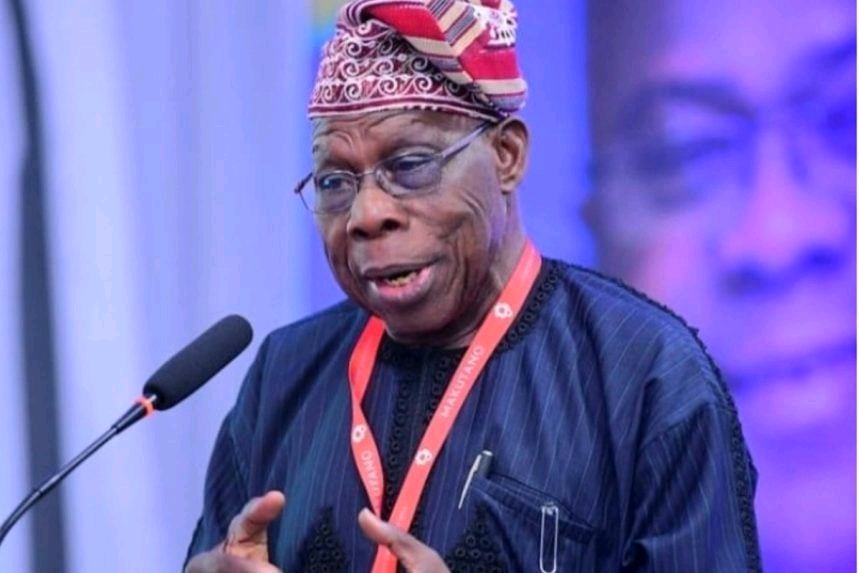

Nigeria’s former president, Chief Olusegun Obasanjo, on Wednesday said that some of the factors that led to the 1967 Civil War are still with us as a nation. He also said he could not give account of what happened at the infamous ‘Asaba Massacre’ during the war.
Obasanjo dropped these hints in his remarks during the presentation of historical document on Nigeria’s Civil War entitled ‘Asaba Massacre’ by the Isama Aje of Asaba, Chief Chuck Nduka-Eze, at the Olusegun Obasanjo Library (OOPL), Abeokuta, Ogun State.
The former president noted that some issues that led to the war are still operating within institutions and the people. He prayed against the nation witnessing such experience again.
The former president commended the author of the document published in written and audio-visual form, acknowledging that he is grounded in a substantial and carefully cross-referenced body of evidence, including eyewitness testimonies, recorded interviews, archival materials, audio-visual documentation, and established historical scholarship.
“We pride ourselves that we preserve the past, we capture the present, and we inspire the future. We capture the past, and this is the past; we want to capture it, we want to know about it.
“You know that I was involved in the civil war, but when people talk about Asaba massacre, I always confess that I cannot give details of it. Some of the things that led to the Civil War are still on. Now, how long will this be with us?
“I was with a colleague when General Yakubu Gowon said, ‘We will not survive a second civil war as a country’. And I believe that we have fought one civil war too many already. So, to say that we will have a second Civil War, God forbid!
“We condemn what happened that should not have happened, and then make sure that we do everything humanly possible to prevent its recurrence.
Nduka-Eze said the documents (serve) as a substantial and carefully cross-referenced body of evidence, including eyewitness testimonies, recorded interviews, archival materials, audio-visual documentation, and established historical scholarship.
He said across independent sources, a clear and consistent account emerges of events following the entry of federal troops into Asaba, then a civilian population centre in the Mid-West region.
He said: “The evidence establishes a recurring pattern. Civilians were assembled in public places under conditions of fear and uncertainty. During these assemblies, residents were required to proclaim allegiance to the Nigerian State, including being instructed to declare ‘One Nigeria’ and otherwise demonstrate loyalty.
“Men were then separated from women and children. Thereafter, unarmed male civilians were killed in a manner consistently described across multiple independent accounts.
“Compliance with these demands did not secure protection. The sequence, repeated across testimonies, reflects a tragic contradiction in which individuals who openly affirmed their identity and loyalty as Nigerians were nonetheless killed in the most undignified manner by the same Nigerian State that they pledged their allegiance to.
“While precise casualty figures cannot be definitively fixed, the convergence of credible evidence points to a substantial loss of civilian life (over a thousand men) and a profound rupture in the fabric of the Asaba community.”
