



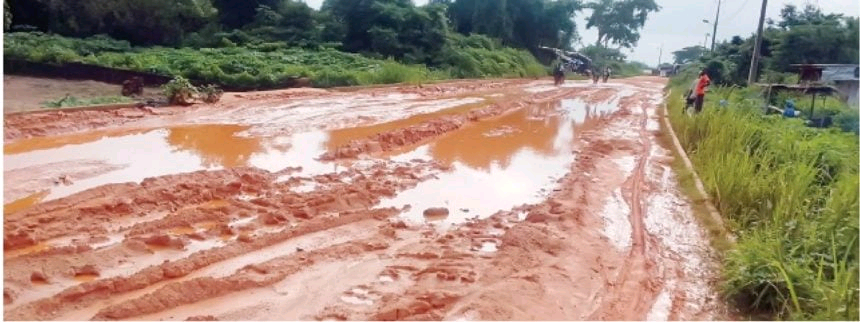

More than ₦1.6 billion in federal payments has already been released for the reconstruction of the 17-kilometre Ayegun-Oleyo Road in Oluyole Local Government Area of Oyo State, a sum that exceeds the entire ₦1.5 billion budgeted for the project in 2023. Yet the road remains visibly unfinished, its identifying project signboards have disappeared from both ends, and residents along the corridor say they are left battling dust, mud and worsening transport conditions.
Now, the 2026 Appropriation Bill lists the project as “ongoing” once again, with a fresh allocation of ₦2.1 billion—bringing the total federal funds earmarked for the road to about ₦3.8 billion, without any public accounting of how the first ₦1.6 billion was spent.
On February 12, 2026, Senator Yunus Akintunde, who represents Oyo Central and lobbied for the road’s inclusion as a federal project, posted footage of the site on Facebook with the caption: “Work in progress… Promise made and kept to the glory of God.” The video showed graded earth and drainage works along the route.
However, during repeated visits to the site by the Saturday Tribune since then, no contractor personnel or active construction work were seen. The project signboards, which once displayed President Bola Tinubu’s photograph alongside the contract details (information that enables citizens to verify who is executing a public project and at what cost), had also disappeared.
On Ayegun-Oleyo Road
What the payment records show
The Ayegun-Oleyo Road, Project Code SUP2023116, received a ₦1.5 billion allocation under the 2023 Supplementary Budget. The Federal Executive Council awarded the main construction contract on March 25, 2024.
Records on the Federal Government’s GovSpend transparency portal show the following payments linked to the project:
September 24, 2024: ₦1,279,800,055.81 (Part payment for road construction)
September 30, 2024: ₦359,069,767.44 (Part payment for road construction)
September 8, 2024: ₦61,526,734.88 (Engineering design consultancy)
March 8, 2023: ₦38,137,740.62 (FERMA rehabilitation of Taska Junction–Ayegun Oleyo–Baare Road)
December 15, 2023: ₦24,255,877.72 (FERMA rehabilitation, listed on the payment record as Ogun State although the described route is in Oyo State—a discrepancy in the government’s own documentation).
Together, the two payments to the main contractor alone total ₦1,638,869,823.25. Both were recorded as “part payment”, not final settlement, and together exceed the project’s original appropriation by about ₦138 million. Both payments were made within one week in September 2024. Including the two FERMA rehabilitation payments made before the main contract was awarded, federal agencies have disbursed close to ₦1.73 billion on a road whose construction has stalled and whose identifying signboards have vanished.
A fresh ₦2.1bn, with no accounting for the first ₦1.6bn
The project has now resurfaced in the 2026 Federal Government budget. Under the Federal Ministry of Works, the Appropriation Bill lists “Construction of Ayegun-Oleyo Road” (Project Code ERGP12231274) as an ongoing project with a fresh allocation of ₦2.1 billion.
That allocation appears alongside dozens of other ongoing federal road projects, including the Illara-Iselu Road and the Ilesha-Etioni-Atakumosa Road in Osun State. Ordinarily, such entries would attract little attention in a 2,790-page budget document. But this case is different. The road has already absorbed more than its original appropriation, remains unfinished on the ground, and neither the contractor nor the sponsoring lawmaker has publicly explained how the earlier funds were utilised.
Living with the road
For residents living along the corridor, the figures on GovSpend mean little compared with the daily reality of the road.
Baba Hikmah, a welder who has lived in the area since 1992, recalled that residents initially widened and graded the road themselves long before government intervention.
On Ayegun-Oleyo Road
“The road was narrow then, and it was gradually expanded by the people themselves. We contributed money and helped grade it,” he told the Saturday Tribune. It was, he said, Senator Akintunde who later facilitated its adoption as a federal road.
Residents say that community effort has now been undone by the reconstruction project. Another resident, Babawale Hammed, said residents had previously built drainage channels “area by area,” only for contractors to block much of them after claiming they could not work around the structures. According to residents, granite had been spread on parts of the road in preparation for asphalting, but work stopped at that stage, leaving long stretches covered with loose stone and earth.
When rain does not fall, dust remains residents’ biggest complaint. Usama Akindele, a student of Ladoke Akintola University of Technology, said returning home from school had become an ordeal.
“Entering home, the first thing I do isn’t greet my parents; I go straight to bathe and shake off the clay dust from my clothes. The road is a choking hazard.”
Trader Temitayo Olawale put it differently.
“I clean my shop every day, only for it to be covered by dust minutes later. Clothes, skin—everything is affected. The road itself does the ‘make-up’ for everyone.”
Hammed added that the dust penetrates vehicles even with the windows shut, causing coughing and eye irritation. He said contractors should regularly wet the road to minimise the problem.
Whenever it rains, dust gives way to mud with pedestrians and motorists struggling to move on the road.
Danger, health, and no emergency care
Beyond the dust and mud, residents say the condition of the road has become a matter of life and death.
In Abodan community, Mrs Lola Oladokun described a community that becomes virtually isolated during the rainy season.
“During the rainy season, we find it difficult to move within the community,” she said. “Many people have left their homes and rented houses in town because of the poor condition of the road.”
According to her, many motorcycle and tricycle operators now avoid the route, making it difficult for traders to transport their goods.
“I had to drop my goods somewhere and walk to my shop. My children have to do the same.”
With no hospital or health centre nearby, she said ordinary medical emergencies often become life-threatening.
“We fear emergencies because they can feel like a death sentence,” she said, recounting one incident—an account the Saturday Tribune could not independently verify—in which a woman reportedly died after she could not be transported for urgent medical care.
She added that accidents and delays linked to the road’s poor condition had also claimed lives. Even attending church on Sundays, she said, sometimes requires spending up to three hours searching for a commercial motorcycle willing to ply the route. A journey home after closing at work at 2 p.m. can extend until 5 p.m.
“The government needs to take action,” she said. “They do some work on the road and then disappear for a long time without any progress. They have stopped working altogether.”
Getting to Abodan itself illustrates the problem. During a visit by this reporters, a motorcycle trip that would ordinarily cost about ₦1,200 eventually cost ₦6,000 for a return journey after nearly an hour’s wait for a rider willing to take the risk. The rider said his motorcycle was less than one year old. It did not look it.
The agencies respond
Presented with the GovSpend records and asked about the missing project signboards, officials at the Federal Ministry of Works’ field office at the Federal Secretariat, Agodi, Ibadan, declined comment and referred all enquiries to the Ministry’s headquarters in Abuja. As of press time, no response had been received, including on the fresh ₦2.1 billion allocation in the 2026 budget.
FERMA’s Zonal Director in Ibadan was also unavailable to explain the rehabilitation payments made in 2023 on a road that now shows no active construction.
