



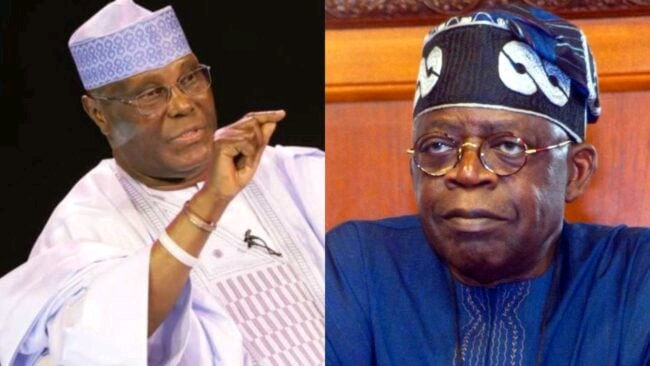

Former Vice President Atiku Abubakar has dismissed the State House’s lengthy defense of President Bola Ahmed Tinubu’s economic record as a desperate attempt to substitute propaganda for performance.
Reacting on Monday through his Senior Special Assistant on Public Communication, Phrank Shaibu, the presidential candidate of the African Democratic Congress (ADC) insisted that no amount of statistical manipulation could erase the daily suffering of millions of Nigerians.
Atiku said it was remarkable that the presidency devoted thousands of words to attacking the opposition while failing to answer the one question every Nigerian is asking: If the economy is doing so well, why are Nigerians getting poorer?
He said it was even more ridiculous that the same Tinubu administration that is simultaneously implementing the 2024, 2025, and 2026 budgets is now asking Nigerians to forget the consequences of its economic decisions in earlier years.
“As the Yoruba rightly say, the one who defecated yesterday may quickly forget, but the person who cleaned up the mess never does. Nigerians have not forgotten the pain this administration unleashed through the disastrous management of every fiscal year since 2024. Those wounds remain fresh, and no amount of revisionism, selective statistics, or government propaganda can erase them.”
Atiku said the presidency’s response was remarkable not for the strength of its arguments but for the contradictions it inadvertently exposed.
“The State House celebrates macroeconomic indicators while ordinary Nigerians struggle with microeconomic realities. It speaks glowingly about GDP growth while families skip meals. It boasts of debt ratios while businesses shut their doors. It trumpets reforms while millions of citizens slide deeper into poverty. It applauds statistical improvements while market women, artisans, manufacturers, transporters, and young graduates confront an economy that has become increasingly hostile to honest enterprise.”
The former Vice President noted that even institutions frequently cited by the presidency have consistently warned that macroeconomic stabilization has yet to translate into broad improvements in living standards.
The latest IMF Article IV Consultation acknowledged progress in some reform areas but also estimated that 63 per cent of Nigerians now live below the national poverty line, while about 27 million Nigerians faced food insecurity in late 2025.
He said, “Those are not opposition figures; they are the findings of an independent international institution often quoted by the government itself.
“Governments are not elected to improve spreadsheets,” Atiku said. “They are elected to improve the lives of their people. Nigerians cannot eat GDP. They cannot cook with debt-to-GDP ratios. They cannot pay school fees with statistical projections. The true measure of economic management is whether families are living better today than they were yesterday. On that score, this administration has failed.”
Atiku said his response would therefore address, point by point, the major claims advanced by the presidency and demonstrate why no amount of official spin can conceal the widening gap between government narratives and the daily realities confronting millions of Nigerians.
Atiku said the presidency’s first line of defense—that the opposition is relying on 2024 figures—is not only intellectually dishonest but an admission that the administration wants Nigerians to develop selective amnesia.
“The Tinubu administration is asking Nigerians to forget the very policies whose consequences they continue to endure every day. That is both convenient and absurd. The economic shocks unleashed in 2024 did not disappear with the turning of the calendar. Their consequences continue to define the lives of millions of Nigerians in 2026.”
“The same government that is simultaneously implementing the 2024, 2025, and 2026 budgets cannot turn around and argue that Nigerians should stop examining the damage caused by its earlier fiscal decisions. Economic policy is not a light switch. The consequences of reckless decisions linger long after the announcements have faded.”
The former vice president said President Tinubu inherited challenges, just as every administration does, but after more than three years in office, his government must accept responsibility for its own record instead of constantly reaching back nearly two decades to blame previous administrations.
“No serious government can continue governing by looking in the rearview mirror. Nigerians are interested in today’s realities, not endless excuses about yesterday.”
Atiku said the presidency’s repeated celebration of GDP growth exposes a dangerous disconnect between government statistics and the lived realities of ordinary Nigerians.
“The presidency proudly announced that Nigeria’s GDP has increased significantly since the exchange-rate adjustment. We ask a simple question: Has the purchasing power of the average Nigerian increased? Can civil servants buy more food today than they could three years ago? Are transport fares lower? Are manufacturers paying less for energy? Have small businesses become more profitable?”
“The answer, tragically, is no.”
He noted that even the International Monetary Fund, whose report the Presidency repeatedly cites as validation of its policies, cautioned that conditions remain difficult for many Nigerians, estimating that 63 per cent of Nigerians now live below the national poverty line, while about 27 million Nigerians faced food insecurity in late 2025.
“Those are not opposition figures. They are the findings of the same institution the government celebrates whenever it commends aspects of its reforms.”
“Governments are not elected to improve spreadsheets. They are elected to improve lives. Nigerians cannot eat GDP. They cannot cook with exchange-rate adjustments. They cannot pay school fees with macroeconomic indicators. Until economic growth translates into fuller stomachs, lower prices, decent jobs, and improved living standards, it remains a failure of humanitarian crisis proportions.”
He added that it was telling that the federal government itself recently announced plans to begin measuring poverty, household income, and inequality in order to prove that reforms are benefiting ordinary Nigerians.
“That announcement is itself an admission that macroeconomic stability alone is not enough. If GDP figures alone told the whole story, there would be no need for a new ‘shared prosperity’ scorecard. Even the government now recognizes that the true test of economic policy is whether citizens are actually living better.”
Responding to the presidency’s argument that Nigeria’s debt-to-GDP ratio remains moderate, Atiku said the government had deliberately avoided the real issue.
“No serious economist argues that borrowing is inherently wrong. Nations borrow. The real question is this: what has Nigeria obtained in return for the unprecedented debts accumulated under this administration?”
“A debt-to-GDP ratio is only one indicator. Equally important is whether borrowed funds generate productive investments, improve infrastructure, create jobs, strengthen public services, and raise living standards. On these measures, Nigerians have every right to ask difficult questions.”
He noted that while the presidency celebrates debt ratios, Nigerians continue to grapple with unreliable electricity, worsening insecurity, rising unemployment, collapsing purchasing power, and one of the most severe cost-of-living crises in recent history.
“The IMF itself has observed that while macroeconomic stability has improved, poverty and food insecurity remain severe and fiscal transparency must continue to improve. Those warnings cannot simply be edited out because they are inconvenient.”
Atiku said the contradiction at the heart of the Presidency’s argument remains unanswered.
“If revenue has improved so dramatically, if subsidy has been removed, if tax collection has increased, and if debt servicing has supposedly become more manageable, why does this administration continue to borrow at record levels? Why are Nigerians being told to celebrate improved revenues while the government simultaneously accumulates fresh debt?”
“That contradiction goes to the heart of this debate. Nigerians deserve answers—not applause lines.”
Turning to the presidency’s defence of fuel subsidy removal, Atiku said Nigerians have never opposed difficult reforms but rejected hardship without accountability.
“No serious economist disputes that fuel subsidies had become unsustainable. The real question has never been whether subsidy should be removed. The question is, “Where are the gains?”
He said the Tinubu administration promised that subsidy removal would free enormous resources for infrastructure, healthcare, education, transportation, and social protection.
“Three years later, Nigerians are entitled to ask, ‘Where are those dividends? Instead of relief, they have experienced the highest fuel prices in history, unprecedented transport costs, soaring food inflation, collapsing purchasing power and an economy where millions now struggle to afford even one decent meal a day.”
“Government cannot ask citizens to celebrate sacrifice while the promised rewards remain invisible.”
The former Vice President said it was ironic that while the Presidency claimed subsidy had been eliminated, it also admitted that substantial crude oil revenues remain tied down by obligations arising from subsidy-related financing arrangements.
“The Presidency cannot simultaneously claim victory over subsidy while explaining away missing oil revenues by pointing to obligations created by subsidy financing. That contradiction speaks louder than any press statement.”
Atiku noted that the Presidency celebrated increased allocations to states and local governments as proof that subsidy removal had succeeded.
“Yes, FAAC allocations have increased significantly. But increased allocations are not an end in themselves. They must translate into visible improvements in the lives of citizens.
“If revenues flowing to all tiers of government have reached unprecedented levels, why are Nigerians still confronted with collapsing purchasing power, worsening insecurity, rising unemployment, and deepening poverty?”
He said the federal government cannot take credit for higher allocations while distancing itself from the deteriorating living conditions across the country.
“The purpose of public finance is not merely to move money between government accounts. It is to improve the welfare of the people. On that score, Nigerians remain unconvinced.”
Atiku dismissed the presidency’s attempt to describe increased allocations as “true federalism.”
“True federalism is not simply sending more money to states after unleashing inflation on the entire country.
“True federalism means devolving powers, strengthening institutions, respecting constitutional responsibilities and allowing sub-national governments to become genuine centres of economic productivity.
“Passing the burden of economic hardship to states while the Federal Government continues to centralise power is not restructuring. It is merely devolving pain.”
Responding to the Presidency’s claim that its tax reforms are progressive, Atiku said no tax policy can succeed in an economy where businesses are already struggling to survive.
“Government cannot tax its way into prosperity while simultaneously shrinking the productive capacity of the economy.
“Manufacturers are battling record energy costs. Small businesses face multiple taxes, rising electricity tariffs, escalating logistics expenses, and declining consumer demand. Families are paying more for virtually every essential service.”
“A tax reform that expands government revenue while ordinary citizens become poorer cannot honestly be described as progressive.”
He added that successful tax systems are built on expanding productivity, creating jobs and widening the tax base through economic growth—not by extracting more from an already distressed economy.
Atiku described the presidency’s explanation on the so-called oil windfall as the most revealing part of its entire response.
“In attempting to rebut our position, the presidency inadvertently strengthened it. It admitted that despite higher international crude oil prices, Nigerians cannot fully benefit because substantial volumes of the nation’s crude have already been committed under crude-backed financing arrangements.
“That is not a defence. It is an indictment.”
He said if Nigeria’s future oil earnings have been encumbered to such an extent that citizens cannot enjoy the benefits of favourable international oil prices, then the administration has merely replaced one fiscal burden with another.
“If the proceeds of Nigeria’s most valuable natural resource have already been committed through opaque financing arrangements, Nigerians deserve full disclosure.”
“Who authorized these transactions? How many barrels have been pledged? What are the repayment terms? How much has been received? Which projects have been financed? Who are the counterparties? These are not political questions; they are constitutional questions about transparency and accountability.”
The former vice president said transparency—not propaganda—is the true test of fiscal responsibility.
“No government that refuses to fully disclose the terms under which future crude oil revenues have been committed can credibly lecture Nigerians about prudence and accountability.”
“If the subsidy has truly ended and the reforms are yielding the benefits being advertised, Nigerians deserve to see those benefits reflected not merely in government spreadsheets but in their homes, their businesses, and their daily lives.”
Responding to the Presidency’s claims of unprecedented achievements in the health sector, Atiku said healthcare cannot be measured by the number of projects commissioned or facilities refurbished but by whether ordinary Nigerians can obtain quality medical care without being driven into poverty.
“The presidency speaks proudly of revitalized primary healthcare centers, cancer treatment facilities, and free cesarean sections. These initiatives are welcome where they genuinely exist and function. But they cannot conceal the broader reality confronting millions of Nigerians.”
Atiku said it is important to remind Nigerians that the Federal Ministry of Health itself informed the National Assembly during the 2025 budget implementation review that only ₦36 million had been released to the ministry under the 2025 Appropriation Act, stressing that “That is not the testimony of the opposition; it is the official position of the government itself. A government that has released such a paltry sum to its health ministry can hardly claim to be leading a healthcare revolution.”
He said it was equally astonishing that the Tinubu administration would cite maternal healthcare as one of its signature achievements when Nigeria continues to rank among the countries with the highest maternal mortality burden in the world.
“With maternal mortality estimates ranging between 993 and 1,047 deaths per 100,000 live births, Nigeria remains in the company of countries such as South Sudan and Chad on one of the world’s most tragic health indicators.
“A government should not measure success by the number of programmes it announces but by the number of mothers who survive childbirth. Until Nigeria ceases to be one of the most dangerous places in the world for a woman to give birth, self-congratulation on maternal healthcare is both premature and insensitive.”
“The ordinary Nigerian is asking a far simpler question: Can I afford to see a doctor? Can I buy prescribed medicines? Can I obtain quality treatment without selling my property or borrowing money?”
He noted that despite government claims, Nigeria continues to battle one of the world’s highest rates of out-of-pocket healthcare spending, while thousands of Nigerian doctors and other healthcare professionals continue to leave the country in search of better working conditions.
“No healthcare system can be declared a success while hospitals continue to lose skilled professionals, patients struggle to afford treatment, and those who can afford it—including senior public officials—still seek medical attention abroad.”
The former Vice President described the Presidency’s reliance on NELFUND as proof of educational transformation as misleading.
“Helping students finance higher education is commendable. But student loans alone do not constitute education reform.”
“Education begins long before university. Millions of Nigerian children remain out of school. Many schools, particularly in conflict-affected communities, operate under the constant threat of kidnapping and violence. Teachers continue to face poor working conditions, while educational infrastructure remains inadequate across many parts of the country.”
He added that while the government celebrates the absence of prolonged university strikes, genuine educational progress must be measured by learning outcomes, access, quality and employability.
“The success of an education system is not measured by whether students can borrow money. It is measured by whether they receive quality education that prepares them for productive lives in a growing economy.”
Atiku said the Presidency’s extensive list of infrastructure projects could not substitute for measurable improvements in the daily lives of citizens.
“Every administration announces projects. Nigerians are interested in completed projects that reduce the cost of doing business, improve mobility, guarantee stable electricity and stimulate economic growth.
“After record borrowing and record budgets, businesses are still forced to spend enormous sums generating their own electricity. Logistics costs remain among the highest in Africa. Manufacturers continue to struggle under crushing operating costs, while many roads remain in deplorable condition.”
He said infrastructure should be assessed by its economic impact rather than the number of projects announced.
Atiku said the Presidency’s argument that inflation has moderated was technically accurate but economically misleading.
“There is an important distinction between lower inflation and lower prices. Nigerians are not buying inflation rates in the marketplace; they are buying food, medicine, transport and other necessities.
“A reduction in the rate of inflation simply means prices are rising more slowly than before. It does not mean they have returned to affordable levels.”
He noted that food prices remain far above pre-reform levels, while transportation, housing and energy costs continue to consume an increasing share of household incomes.
“Government cannot ask Nigerians to celebrate statistical moderation while families continue to skip meals because food remains unaffordable.”
The former Vice President also challenged the Presidency’s reliance on cash transfers and social intervention programmes as evidence that reforms are protecting vulnerable Nigerians.
