



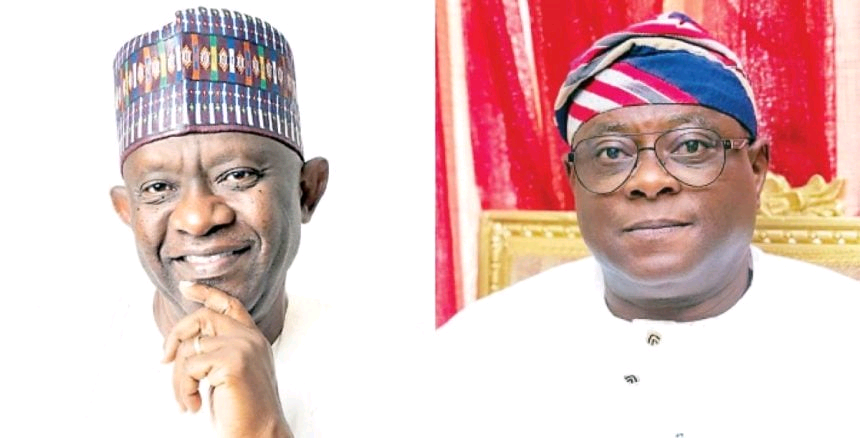

Kogi State correspondent, YEKINI JIMOH, unpacks the unfolding political dynamics within the All Progressives Congress (APC) in Kogi West Senatorial District, concluding that beneath the still waters lie some fast-paced tide capable of sweeping away the best of swimmers.
ON the surface, the All Progressives Congress (APC) remains firmly in control of the political landscape in Kogi West Senatorial District. The party has the structures, the political heavyweights, elected representatives, and a formidable grassroots network that have helped sustain its dominance over the years.
But beneath that impressive political façade, cracks are beginning to show.
The question now being quietly asked across the district is not whether APC remains a strong political force, but whether the party can put its house in order before the 2027 general elections.
At the centre of the emerging storm is the controversy over the party’s Kogi West senatorial ticket. Senator Sunday Steve Karimi, who is currently representing the district in the Senate, was declared the winner of the APC senatorial primary held on May 18, 2026. He was said to have won 51,665 votes. His candidacy was subsequently affirmed by the party, with his name submitted to the Independent National Electoral Commission (INEC). Ordinarily, that should have brought the contest to an end. But that was the beginning of another dramatic scene as the name of Honourable Samuel Bamidele Aro, an aspirant in the May 18, 2026, primary, emerged. Aro had headed to the Federal High Court, Lokoja, where he challenged the process that led to Karimi’s emergence and asked the court to recognise him as the legitimate APC candidate.
What started like a routine post-primary disagreement has therefore developed into a political dispute capable of testing the strength and maturity of APC in Kogi West going forward. It is looking as if the controversy goes far beyond the ambitions of two politicians, to one that is fast exposing the competing interests within the APC family in the state and the senatorial district. The development is also raising fundamental questions about political influence, control of party structures, and the future direction of the party in the district.
Earlier in the year, some APC stakeholders had reportedly backed Hon Aro as a consensus candidate, but the move was said to have been resisted by supporters of Senator Karimi and other aspirants. It was learnt that petitions and appeals were also directed to the national leadership of the party and President Bola Ahmed Tinubu, amidst reports that the Presidential Villa had settled for Senator Karimi. The emergence of Hon Aro has, however, exposed the existence of different political camps within the same party—camps that may share the same party symbol but do not necessarily share the same political beliefs.
That became the reality of Kogi West senatorial district going into the May 18 primary election. And that is where the real danger lies. Observers had noted that in politics, competition is hardly unusual. What matters is whether those who lose the battle for a ticket are willing to join hands with the winner once the contest is over.
When that fails, an internal primary can become the beginning of an electoral crisis, but that is where leaders and stakeholders are expected to come in.
Governor Ahmed Usman Ododo, who, as the governor, is the leader of the party in the state, is believed to be very central to the wider conversation about APC’s unity in Kogi West. Although political developments around the senatorial primary at various points had created the impression of competing interests within the party structure, the governor’s intervention could break the deadlock.
That is why sources stated that a meeting between Ododo and Karimi in June offered a possible indication that efforts were being made to ensure that the stakeholders could close ranks ahead of 2027. It was learnt that Karimi subsequently called for reconciliation and unity within the APC. The development is seen as significant because the governor occupies a strategic position in the state’s political structure, while Karimi remains an important figure in the Kogi West political equation.
Observers believe that if the camps of the governor and that of Karimi can work together, as well as with other influential stakeholders, the current upheaval in the state may become a temporary political skirmish rather than a permanent division. A source, however, said that it is only if reconciliation fails that the state and the district would discover a debilitating quarrel that may have far-reaching effects on the elections. Therefore, as observers have noted, the biggest danger confronting APC in Kogi West may not necessarily come from the opposition. It may come from within the same party.
It has also been said that political parties are often weakened not because their opponents are stronger, but because internal disagreements become so deep that members begin to work against one another. A defeated aspirant who feels cheated may refuse to mobilise supporters for the party. A faction that believes it has been marginalised may begin building an alternative political structure.
Before long, the party’s greatest strength—its numerical and organisational advantage—can become a liability. Such is why the ongoing crack in Kogi West deserves serious attention. Right now, the issue is not just about who occupies the senatorial ticket. It is about whether APC can maintain a united political structure capable of delivering votes when the real contest begins.
APC is not collapsing yet in Kogi West
It would, however, be premature to suggest that APC has lost its grip on Kogi West. The party still commands considerable political influence across the district. It has experienced leaders, elected officials, grassroots politicians, and loyal supporters.
There are also APC stakeholders who continue to publicly express support for President Bola Ahmed Tinubu, Governor Ododo and the party ahead of the 2027 elections.
That means the present situation should perhaps be viewed as a battle within a powerful political family rather than the collapse of the family itself. But political families, like ordinary families, can destroy themselves when disagreements are allowed to fester.
The elders have a role to play.
The calls for reconciliation from political elders and stakeholders should therefore not be dismissed as mere political rhetoric.
They point to a growing recognition that the party cannot afford prolonged internal warfare.
The responsibility now falls heavily on the leadership of APC to create a credible environment where grievances can be addressed and competing interests accommodated.
The party must also make it clear that once the legitimate candidate emerges through the recognised process, every member has a responsibility to work for the collective success of the party.
At the same time, reconciliation cannot simply mean asking aggrieved members to forget their concerns. There must be confidence that the process was fair, transparent and respected.
For Senator Karimi, the challenge goes beyond defending his ticket.
If he eventually carries the APC flag into the election, he will need to convince members who opposed his emergence that there is still a place for them in the party.
Winning the primary is one battle.
Building a united campaign structure is another. The senator’s ability to reach out across political divides within the party could prove just as important as his personal political strength. His opponents, too, face a critical decision. They must determine whether continued resistance is worth the potential damage it could cause to the party they belong to.
The next few months could determine the political direction of Kogi West. APC has two options. It can allow the present disagreement to deepen, creating factions that operate almost like separate political parties. Or it can seize the opportunity for genuine reconciliation and emerge from the crisis stronger and more cohesive.
The opposition will certainly be watching. If APC enters the 2027 contest united, its existing political structure could give it a significant advantage. But if the party enters the election divided, opposition forces may not need to do much to exploit the cracks. Incidentally, the Peoples Democratic Party(PDP) is waiting in the wings to exploit the cracks within the APC. It was understood that the PDP had picked a ranking member of the House of Representatives, Hon Tajudeen Yusuf, as its candidate. Yusuf hails from Kabba Bunu axis and is a well-known face among political stakeholders in the zone.
So, Is APC Really Alright in Kogi West? The answer is still difficult to hazard, as the party remains strong, while its unity is being tested. The controversy surrounding the senatorial ticket, competing political interests, petitions, allegations of factional influence, and the court battle are all warning signs. Recently, the suit by Hon Aro against Senator Karimi was moved to Abuja. The last has not been heard on the case.
Yet, the cracks have not necessarily become a collapse for the party. Sources said that there are still some months to repair the crisis. The real test of APC’s leadership will therefore not be how it manages victory, but how it manages disagreement.
Kogi West politics has always been fiercely competitive.
Kogi West has always been a hotly contested senatorial district, and going by the developments so far, the 2027 election may not be different. However, APC’s biggest battle may not be against another political party. It may first have to defeat the divisions within its own ranks. If it succeeds, the party could enter 2027 stronger, more united and more difficult to dislodge. If it fails, the opposition may not need to defeat APC from outside.
APC could weaken itself from within.
