



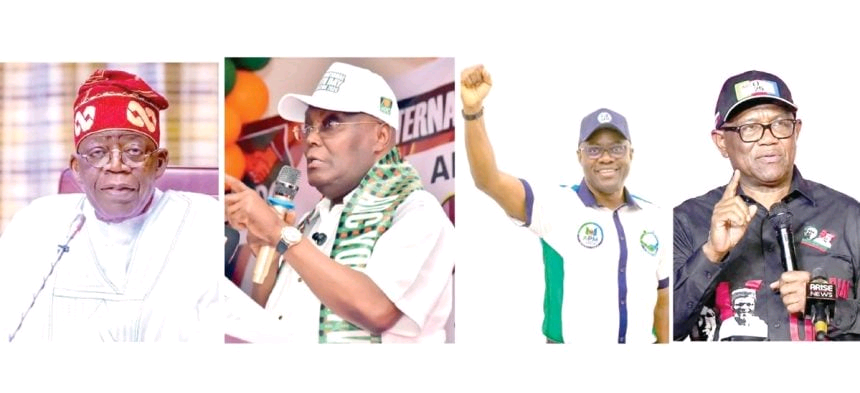

•Issues as campaign process unfolds
In this report, General Editor Politics, TAIWO ADISA, examines the unfolding issues as the 2027 election campaign intensifies.
In the wisdom of the National Assembly, the 2026 Electoral Act, which was signed into law in February 2026, provided ample time for electoral campaigns. It is a wide departure from the standard provided under the 2010 Electoral Act (as amended), which remained in force till 2022. During the operation of that Act, politicians usually complained that the 90-day window provided for campaigns was inadequate for them to cover all the ground. For instance, a presidential candidate is expected to campaign in at least each of the 36 state capitals and round off his campaign in Abuja, the Federal Capital Territory. That compels him to make 37 stops within the 90-day window; the same time was allotted to governorship candidates, senatorial candidates, candidates for the House of Representatives and candidates for state assembly elections. In view of the need to avoid clashes of venues among political parties and contending interests, the security implications of campaigns, and other unforeseeable developments, the National Assembly acceded to the need to widen the length of time available for campaigns from the 2022 Electoral Act. That Act provided a 150-day window for campaigns for the presidential and all other elections.
That provision ensured that candidates for elections emerge a clear year before the next inauguration. For instance, the primaries for the 2023 elections were held between late April and the first week of June 2022, almost a clear year ahead of the inauguration of the next administration. In the build-up to the 2027 election, the Independent National Electoral Commission (INEC) released an electoral calendar which sanctioned the conduct of primaries between mid-April and the end of May 2026, while campaigns are to kick off for the national elections in August, and state elections are to kick off their campaigns in September. Because the 2022 and 2026 Electoral Acts maintain the same 150-day window for campaigns, the timeframe in INEC’s calendar can be understood.
But what has the polity gained despite the elongated period of campaigns? Observers had expected that with the elongated campaign period, candidates would engage the electorate more, while campaigns would become more issues-based.
Rather than the electorate being treated to a flood of campaigns, political parties have become more tentative rather than engaging in the campaign season.
For instance, our sister publication, the Nigerian Tribune, asked political parties why they had yet to inaugurate campaign councils weeks after the electoral commission lifted the ban on presidential campaigns in August. Indeed, more than a month after the flag-off of the campaigns for presidential and National Assembly elections, none of the major political parties has inaugurated its campaign council. The All Progressives Congress (APC), which announced its Presidential Campaign Council (PCC) on August 22, failed to inaugurate the same, and the party’s presidential campaign indeed went on a three-week leave afterwards. The national chairman of the party, Professor Nentanwe Yilwatda, also announced a foreign trip, which appeared to have effectively killed the campaign initiative of the ruling party.
But the national secretary of the party, Senator Ajibola Bashiru, said that the failure of the party to inaugurate its PCC does not stop the campaigns from going on as scheduled. Indeed, the party declared that it had started campaigning with or without the PCC’s inauguration.
According to Senator Bashiru, the inauguration of the PCC was a mere ceremony, adding that certain members of the campaign council have since commenced campaigns for the party’s presidential candidate.
He said: “Nothing is really delaying the inauguration. In fact, I can tell you that campaigns have started. When we are ready, we will do a formal inauguration.
“You must have noticed that we have started our campaigns already. The party’s national leadership was in Kano on Saturday, where we received the likes of Senator Kabiru Gaya, Senator Hanga Rufai, and others who joined our party.
“Also on Saturday, there was an elaborate event in Ikwerre in Rivers State. The Director-General of the Campaign Council, Senator Yari, was also in Gusau to receive those who joined the party in Zamfara State.
“So, we don’t have to wait until the formal inauguration before we start to talk to the electorate. We have started our campaigns. When we are ready, we will do the formal inauguration.”
The ADC, which took a long time to announce its presidential campaign committee, only did so in the third week of September. Insiders in the party had told the newspaper that the leaders were trying to avoid the pitfalls of the past and that they were trying to blend the committee in a way that new blood would coalesce effectively with the old guard.
All the contending political parties in the 2027 race are so far guilty of delayed campaign flag-off. Thus, rather than take advantage of the elongated campaign period provided by the Electoral Act, the politicians have only defeated the logic behind the idea.
However, sources within the parties told the Sunday Tribune that the parties have been battling post-primary peculiarities, which appear peculiar to the 2027 election.
For instance, the Accord Party is yet to figure out a presidential candidate, as matters between the party and its presidential hopeful, Gbenga Hashim, appeared stuck in the judiciary. The National Democratic Congress (NDC) is also affected by the undue mudslinging that appears to characterise the 2027 campaign build-up.
