




At 66, Nigeria confronts stark economic irony, as CHIMA NWOKOJI writes on how, once an IMF and World Bank lender, the country has now become a heavy borrower despite rising revenues.
NIGERIA marked its 66th independence anniversary last week, but the nation confronts a stark economic irony. A country that once stood as a lender and contributor to the International Monetary Fund and the World Bank now ranks among their significant borrowers, even as its revenue receipts climb year after year.
Under General Yakubu Gowon, Nigeria once possessed sufficient reserves to lend $240 million to the World Bank and $120 million to the IMF. At the height of the 1970s oil boom, rising petroleum revenues strengthened the country’s foreign reserves and global economic position. In 1974 alone, Nigeria committed about $360 million to the two institutions.
World Bank records document the arrangement as a loan from Nigeria to the bank. Nigeria’s influence extended beyond finance; in the 1950s and 1960s, members of Saudi Arabia’s royal family reportedly travelled to University College Hospital in Ibadan for treatment.
Today, the picture has reversed. Nigeria holds more than $20 billion in original International Development Association credits and about $2.85 billion in International Bank for Reconstruction and Development loans. It currently has no outstanding IMF credit after repaying its remaining financing in 2025. From lender and medical destination to one of the World Bank’s larger borrowers and a source of medical tourism outflow, the transformation has been dramatic.
Debt trajectory under Tinubu administration
Nigeria’s external debt stock has risen by about $11.4 billion since President Bola Tinubu assumed office in 2023. It expanded from roughly $43.1 billion to $54.5 billion as of June 2026. The increase reflects a preference for foreign borrowing to finance economic reforms, budget deficits and development programmes.
Debt to the World Bank climbed from about $15.4 billion to $20.7 billion in the period. Major financing approved under the current administration included $2.25 billion for economic reforms in June 2024, $1.57 billion for the HOPE and SPIN programmes in September 2024, and $1.08 billion for education and resilience programmes in March 2025.
Meanwhile, the Federal Government is seeking a fresh $1.5 billion in financing from the World Bank through three loans targeting climate resilience, early childhood development and social protection.
This is coming after seeking $1.25 billion World Bank loan to support access to finance, digital services and electricity, while backing reforms in tax, trade and agriculture.
Nigeria returned to the international capital market in December 2024 with a $2.2 billion Eurobond ($700 million due 2031 and $1.5 billion due 2034). It followed with another $2.35 billion Eurobond in November 2025, bringing the total from the two issuances to $4.55 billion.
The country secured a $1.8 billion syndicated loan from First Abu Dhabi Bank and agreed a $5 billion derivatives financing arrangement in 2026, of which $1.5 billion had been drawn by June. Authorities have stressed that no oil revenues or strategic national assets were pledged as collateral, though the IMF has raised concerns about the complexity and transparency of derivatives-based financing, and Fitch has flagged liquidity and creditor-recovery risks.
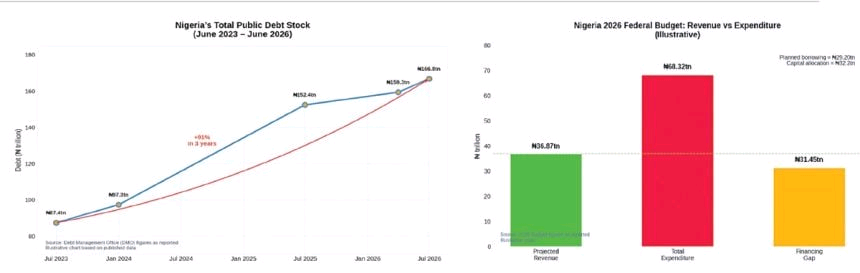
Domestic debt has also risen sharply, from about N59.1 trillion to N91.5 trillion. The Debt Management Office reported total public debt of N166.79 trillion as of 30 June 2026—N91.59 trillion domestic and N75.20 trillion external. The federal government accounted for roughly N152.77 trillion, while states and the Federal Capital Territory held approximately N14.01 trillion. In dollar terms, the stock stood at about $120.93 billion.
Compared with N87.38 trillion at 30 June 2023, the nominal debt stock is about N79.41 trillion higher, or roughly 91 percent larger. An increase in the naira value of debt is not identical to an equivalent volume of new borrowing, given exchange-rate movements, yet the directional trend is unambiguous.
Rising revenue, larger financing gap
Federal Government aggregate revenue increased from N12.48 trillion in 2023 to N20.98 trillion in 2024—an increase of approximately N8.50 trillion, or 68.1 percent. By November 2025, revenue had reportedly reached about N22 trillion. The composition of 2024 revenue is revealing: gross non-oil revenue of N16.09 trillion exceeded its estimate by about N5.29 trillion, while oil revenue of N15.07 trillion fell about N4.93 trillion short of target.
Available records show that revenue growth has therefore been driven increasingly by taxation and other non-oil sources.
Yet the N20.98 trillion still fell approximately N4.89 trillion short of the 2024 budget projection, an 18.9 percent shortfall. Higher revenue has not closed the financing gap because expenditure has risen faster.
The approved 2026 budget provides for approximately N68.32 trillion in total expenditure against N36.87 trillion in projected revenue, producing a financing deficit of roughly N31.45–N31.46 trillion. Planned borrowing stands at N29.20 trillion, up from an earlier figure of about N17.89 trillion. The arithmetic is straightforward: revenue of roughly N36.87 trillion against expenditure of N68.32 trillion leaves a gap that must be filled by borrowing and other financing sources.
For example, Taiwo Oyedele, Minister of Finance and Coordinating Minister, said the resources generated through the reforms, alongside additional revenue and borrowing, gave the Federal Government incremental resources of N20.4 trillion during the period. However, the federal government’s incremental expenditure stood at N30.64 trillion.
Only recently, the Federal Government says it spent N9.39 trillion on wage adjustments, minimum wage increases and allowances for public servants between June 2023 and December 2025.
“The implication of this is that the pressures we have on inflation is partly driven by these deficits because the government is spending more than it is generating, so it is pumping a lot of liquidity into the economy which is coming from Ways and Means funding,” according to the Chief Executive Officer, Cowry Asset Management Limited, Johnson Chukwu.
Where the money is going
The 2026 budget allocates approximately N32.2 trillion to capital expenditure, N15.8 trillion to debt service, N15.4 trillion to recurrent expenditure and N4.799 trillion to statutory transfers. Capital spending represents roughly half the total budget. Major sectoral allocations include about N5.41 trillion for defence and security, N3.56 trillion for infrastructure, N3.52 trillion for education and N2.48 trillion for health.
The economic rationale is clear. Infrastructure can reduce transport, energy and logistics costs. Agricultural investment can expand production and agro-processing. Education and health can raise human capital and labour productivity. Security can make commercial activity safer. Energy investment can increase electricity supply and lower production costs. These are valid channels through which public investment can generate future growth.
An allocation, however, is not an investment until the money is efficiently spent and produces a functioning asset.
The government’s own 2026 Budget Speech supplies sobering evidence on execution. As of the third quarter of 2025, revenue stood at N18.6 trillion—only 61 percent of target—while expenditure reached N24.66 trillion, about 60 percent of target. Only N2.23 trillion had been released for 2024 capital projects as of June 2025, and merely N3.10 trillion, or approximately 17.7 percent of the 2025 capital budget, had been released by the third quarter of 2025.
In 2024, the Budget Office reported that N5.81 trillion was released and cash-backed for capital projects, yet only about N3.27 trillion had been utilised by ministries, departments and agencies as of 30 June 2025.
Implementation periods have been extended, with the 2025 capital budget initially carried into June 2026 and now December 2026 to allow completion of ongoing projects. The size of the capital budget therefore does not prove that N32.2 trillion of productive investment will actually materialise.
Interest burden and fiscal cycle
The IMF’s 2026 Article IV assessment places the fiscal position in sharper perspective. Federal Government revenue is projected at 4.9 percent of GDP, expenditure at 9.2 percent, capital expenditure at 3.8 percent and the deficit at about 4.3 percent of GDP. Consolidated government revenue and grants stand at approximately 10.8 percent of GDP against total expenditure of about 15.5 percent, yielding an overall balance of roughly –4.7 percent of GDP.
The most critical indicator is interest payments as a share of Federal Government revenue: 40.8 percent in 2024, 53.2 percent in 2025 and a projected 53.7 percent in 2026. More than N50 of every N100 of federal revenue is absorbed by interest. Even when revenue rises, a large proportion is immediately committed to servicing existing debt.
The resulting cycle is difficult: more revenue creates capacity to service debt, yet high interest costs consume much of the additional revenue, leaving less for new productive investment.
The question arises: is the additional borrowing paying for itself? The precise answer is that it has not yet been demonstrated. This does not mean every naira borrowed has been wasted, nor that the economy has failed to improve.
Reserves have strengthened, growth has hovered around four percent and the external position has improved. It means there is currently insufficient evidence that the additional borrowing is generating incremental economic output and government revenue at a rate sufficient to exceed the full cost of the debt.
Analysts believe that Nigeria can simultaneously experience economic growth, improved reserves, higher revenue, higher debt and very high interest costs. The decisive test is whether the marginal return on new borrowing is high enough. The productive cycle requires borrowing to finance completed and functioning assets that raise productivity, stimulate private investment and activity, lift household and business incomes, increase tax revenue and thereby lower the relative debt burden. The alternative cycle is what Nigeria experiences today—borrowing that largely services interest, finances recurrent spending or low-return projects—produces insufficient productivity gains and additional revenue, necessitating further borrowing.
Expert assessment and the debt-trap risk
Emeritus Professor of Economics Akpan Hogan Ekpo of the University of Uyo, former Director General of the West African Institute for Financial and Economic Management, cautions that nominal debt-stock comparisons can mislead. The relevant metrics are the debt-to-GDP ratio, debt-to-revenue ratio and debt service-to-revenue ratio. Nigeria’s debt-to-GDP ratio of around 38 percent remains within the IMF’s 40 percent benchmark. Debt service relative to revenue, however, is far more concerning and has reportedly exceeded 60 percent in recent periods.
“GDP does not pay debt; revenue pays debt,” Professor Ekpo emphasises. Nigeria faces a severe revenue challenge, with continued dependence on volatile oil exports, many of which have been securitised through forward sales. He notes that previous administrations front-loaded concessional loans whose grace periods have now expired, and that the current government inherited maturing obligations, including formalised Ways and Means advances.
As long as debts are serviced on schedule, a full-blown crisis is not at hand. Yet borrowing should not be the default response. Public-private partnerships, contractor financing and stronger domestic resource mobilisation remain available options. Transparency and rigorous feasibility studies are essential so that projects pay their way rather than transferring the burden to future generations.
A debt trap arises when a government borrows so extensively that it becomes increasingly difficult to repay existing obligations without taking on additional loans. Rising debt and interest payments absorb more revenue, leaving less for development, which in turn prompts further borrowing. Low revenue, high interest rates, excessive borrowing, weak growth, unproductive use of funds and exchange-rate depreciation can all accelerate the cycle. Nigeria’s present position exhibits elements of pressure without constituting an irreversible trap—provided the capital programme delivers measurable returns.
Decisive question
Nigeria is borrowing more not because revenue has failed to rise, but because expenditure and financing requirements have risen faster still. The 2026 budget illustrates the scale of the gap: N68.32 trillion in expenditure against roughly N36.87 trillion in revenue, with N29.20 trillion in planned borrowing and N32.2 trillion allocated to capital spending. The potential exists for borrowing to finance productive development. The decisive issue remains execution and economic return.
The interest burden has become extremely high. Public debt reached N166.79 trillion by 30 June 2026. The economy is growing and the external position has strengthened. The factual conclusion is therefore measured: Nigeria is experiencing genuine macroeconomic improvement, yet the available evidence does not yet demonstrate that the additional borrowing is generating sufficient incremental output and revenue to cover its full financing cost.
The real question is no longer how much Nigeria is borrowing. For every naira borrowed, what productive asset has been created, what additional economic output has it generated, and how much additional government revenue will it ultimately produce? That is the objective test of whether rising borrowing is financing productive development or merely increasing the future debt-service burden. At 66, Nigeria’s economic story is still being written in the answers to those questions.
