



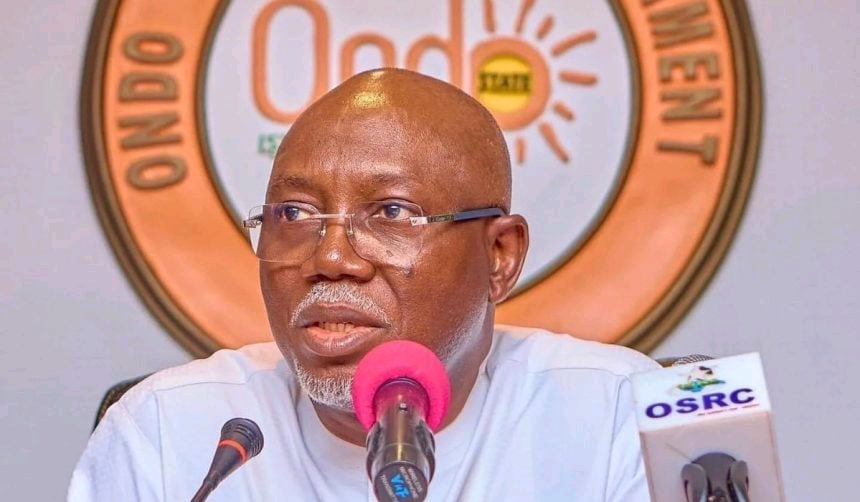

Ondo Governor, Lucky Aiyedatiwa, on Thursday, declared that the dream of the late former governor of the state, Arakunrin Oluwarotimi Akeredolu, for the establishment of State Police will eventually become a reality.
Aiyedatiwa said Akeredolu’s persistent advocacy for a decentralised security architecture had moved beyond regional agitation to become a major issue in Nigeria’s national policy and constitutional discourse.
Speaking at a colloquium to mark Akeredolu’s 70th posthumous birthday in Ibadan, with the theme, “Fundamentals and Governance of State Policing: Towards a New Architecture for National Security in Nigeria.”
Aiyedatiwa described Akeredolu, whom he fondly referred to as “My Oga”, as a courageous and selfless public servant whose ideas continued to influence national conversations on security, federalism and good governance.
According to him, Akeredolu’s legacy should be measured not only by the offices he occupied but by the courage with which he pursued issues he believed were critical to the future of Nigeria.
He recalled Akeredolu’s service as Attorney-General of Ondo State, President of the Nigerian Bar Association, Governor of Ondo State, Chairman of the South-West Governors’ Forum and Chairman of the Southern Governors’ Forum.
The governor said Akeredolu’s advocacy for true federalism was neither rhetorical nor cosmetic, noting that he consistently demanded a security structure that would bring policing closer to the people.
Aiyedatiwa recalled that when insecurity became a major threat to lives and livelihoods, Akeredolu and other South-West governors did not merely complain about the limitations of the existing security structure but established the South-West Security Network, Amotekun Corps.
He said the initiative demonstrated the principle that communities closest to security challenges should have a meaningful role in protecting themselves.
The governor said the recent involvement of the Ondo State Amotekun Corps, alongside the Department of State Services, Nigerian Army and other security agencies, in operations against suspected ISWAP terrorists in the state’s forests had further demonstrated the importance of local intelligence in tackling insecurity.
He said the development had strengthened the argument for a security system built around local knowledge, intelligence and community participation.
Aiyedatiwa said the experience had also elevated the Amotekun initiative beyond a regional security arrangement to an important component of the national debate on State Police and the future of Nigeria’s security architecture.
He said President Bola Ahmed Tinubu had demonstrated commitment to moving the idea of State Police from the realm of debate into institutional reform.
The governor, however, stressed that the creation of State Police must be accompanied by measures capable of making it professional, accountable and worthy of public confidence.
He listed credible recruitment, proper vetting, professionalism and accountability as some of the conditions that must underpin the proposed system.
Aiyedatiwa said the most fitting memorial to Akeredolu would not be monuments, ceremonies or tributes but the emergence of a Nigeria that was safer, more federal, just and responsive to the needs of its citizens.
He said such a system must be capable of understanding security challenges at the grassroots, gathering intelligence before threats escalate, involving communities in their own protection and measuring policing not merely by the power of the state but by citizens’ confidence.
The governor also pledged to continue advancing Akeredolu’s legacy, saying his administration had continued to execute projects initiated by the late governor, particularly road projects discussed during meetings of the State Executive Council.
Aiyedatiwa said Akeredolu worked with the understanding that whoever succeeded him would complete projects that he could not finish during his tenure.
He prayed for God’s continued blessings upon Akeredolu’s family and for the late governor’s memory to remain blessed.
In his keynote address, Ogun State Governor, Dapo Abiodun, said Nigeria needed an additional 554,353 police personnel to meet the United Nations-recommended police-to-citizen ratio.
Abiodun, who chairs the Nigeria Governors’ Forum Committee on State Police, called for comprehensive reforms to ensure that State Police, when established, are effective, sustainable and accountable.
He said the discussion on State Police should go beyond mourning Akeredolu’s death or celebrating his achievements to addressing the structural reforms required to strengthen Nigeria’s security architecture.
According to him, Akeredolu’s vision extended beyond security hardware, as the late governor understood the relationship between security and economic development and contributed to laying the groundwork for the South-West Development Commission.
“A secure region is a prosperous region,” Abiodun said, noting that Amotekun had demonstrated the value of community intelligence and rapid response in combating insecurity.
He said the six geopolitical zones had increasingly recognised that the centralisation of policing could no longer adequately address Nigeria’s security challenges.
“The seeds Aketi sowed have matured into a national consensus,” Abiodun said.
Former Ekiti State Governor and former Chairman of the Nigeria Governors’ Forum, Dr Kayode Fayemi, described Akeredolu as an “irreplaceable defender of the defenceless” and a courageous voice who consistently spoke truth to power.
Fayemi described him as a “man of many parts”, saying Akeredolu was able to relate to both the elite and ordinary Nigerians while combining seriousness in public affairs with a lively personality.
He recalled Akeredolu’s involvement in the Southern Governors’ Forum, where he consistently advocated the rotation of the presidency to the South irrespective of political party considerations.
Fayemi said Akeredolu’s political ideology was anchored on the common good and the desire to bring joy and prosperity to the greatest number of people.
Lagos State Governor, Babajide Sanwo-Olu, described Akeredolu as a steadfast and courageous voice for the interests, dignity and security of the South-West.
Sanwo-Olu, represented by the Lagos State Secretary to the Government, Barrister Salu Hundeyin, said Akeredolu regarded leadership as a responsibility rather than a privilege and demonstrated courage in confronting challenges affecting his people.
He urged Nigerians to draw inspiration from Akeredolu’s convictions and leadership example.
“Aketi may no longer be with us, but his example remains. His voice may have fallen, but the cause for which he stood continues to speak,” he said.
Also speaking, Ekiti State Governor, Biodun Oyebanji, described Akeredolu as a courageous leader whose determination to confront insecurity contributed significantly to the establishment of Amotekun.
Oyebanji, represented by the Secretary to the State Government, Prof. Habibat Omolara Adubiaro, said Akeredolu stood with other South-West governors, across party lines, in confronting insecurity despite opposition from the Federal Government at the time.
He urged governors in the region to deepen regional integration and challenged the South-West Development Commission to embark on ambitious projects capable of transforming the region rather than limiting its interventions to token projects.
The Director-General of the Development Agenda for Western Nigeria (DAWN) Commission, Dr Seye Oyeleye, said Akeredolu was a leading advocate of decentralised policing, insisting that Nigeria could no longer depend solely on a single police force controlled from Abuja.
Oyeleye said the existing arrangement was inadequate for the country’s population and security realities, adding that the experience of Amotekun had demonstrated that state and regional policing could work.
Akeredolu’s first son, Oluwarotimi O. Akeredolu Jr., described his father as a courageous advocate of justice, human rights, political freedom and accountable government.
He recalled his father’s student activism, legal career, involvement in the June 12 struggle, participation in the 2012 fuel-price protest, and his campaign against insecurity.
The colloquium was attended by the wife of the governor, Mrs Esther Aiyedatiwa; Speaker of the Ondo State House of Assembly, Rt. Hon. Olamide Oladiji; Secretary to the State Government, Dr Taiwo Fasoranti; APC State Chairman, Hon. Kolawole Babatunde; Chief of Staff to the Governor, Prince Segun Omojuwa; serving and former members of the State Executive Council, political leaders and other dignitaries.
