



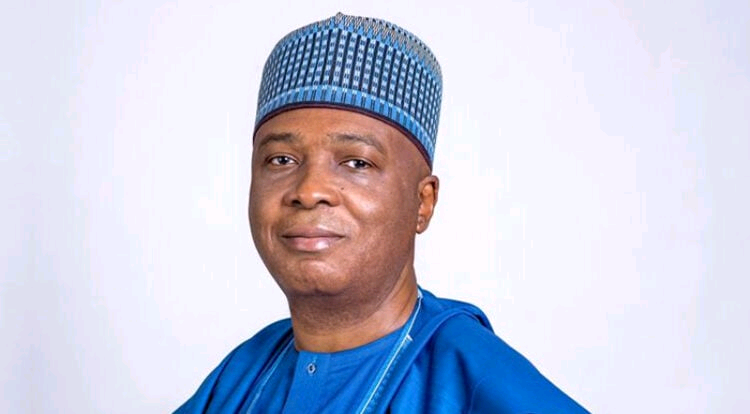

Former Senate President, Dr Bukola Saraki, has revealed how he confronted the administration of late former President Muhammadu Buhari over requests for foreign loans, saying the National Assembly insisted on proper scrutiny of every borrowing proposal before approval.
Saraki made the remarks on Tuesday during the Global Strategic Advisory Group meeting held at Villa La Collina in Lake Como, Italy.
He spoke while participating in a panel discussion titled, “Development Policies—Withdrawal of the U.S. from International Development: Opportunities and Challenges.”
Looking back on his time as Senate President from 2015 to 2019, Saraki said the Eighth National Assembly focused on strengthening fiscal accountability through open budget hearings, closer monitoring of government revenue and reforms in the petroleum sector.
He said, “During my tenure as Senate President, we placed strong emphasis on fiscal oversight, introducing open budget hearings, confronting the issue of unremitted revenues held outside the treasury system, and working on petroleum sector governance reform.
“These were not easy fights. But they were necessary ones, because the alternative is permanent external dependency.”
Saraki said the legislature came under political pressure after insisting on reviewing the purpose and long-term implications of foreign loan requests submitted by the executive.
“I experienced this firsthand when, as Senate President of Nigeria, I challenged the executive on foreign loan approvals and received significant political push-back because the system was not designed to support proper scrutiny of purpose or impact.
“Many of these loans were accepted as if they were free gifts, yet repayment obligations remained,” he said.
The former Kwara State governor also raised concerns over Nigeria’s low tax-to-GDP ratio, describing it as one of the country’s biggest barriers to sustainable economic growth. He warned that continued dependence on foreign aid and external borrowing could weaken Nigeria’s economic independence.
Saraki urged African countries to improve domestic revenue generation and strengthen public institutions instead of relying heavily on development assistance.
He said, “Tax-to-GDP ratios across Sub-Saharan Africa average approximately 15.6 per cent, compared to an OECD average of 34 per cent.
“Nigeria’s is approximately six per cent, one of the lowest in the world for an economy of its size.
“This is a political choice. And political choices can be changed by political leadership.”
He said Africa must move away from dependence on foreign donors by embracing trade, industrialisation, value addition and stronger institutions as the foundation for long-term development.
Saraki added that although the reduction in United States development funding presents immediate financial and humanitarian challenges, it also creates an opportunity for African nations to rethink their development strategy.
He encouraged African governments to deepen partnerships with Europe, China, India, the Gulf states and other emerging economies, stressing that such relationships should be based on mutual benefit rather than replacing one form of dependency with another.
Saraki also called for greater transparency in public finance, stronger legislative oversight, an independent judiciary, credible elections and improved fiscal discipline, saying these are essential for sustainable economic progress.
He further advocated faster implementation of the African Continental Free Trade Area, increased investment in young people, education and innovation, as well as greater mobilisation of domestic and diaspora capital to support Africa’s development.
He urged African leaders to take advantage of the changing global landscape to build an economy driven by production, innovation, self-reliance and strategi
c partnerships instead of continued reliance on foreign aid.
