



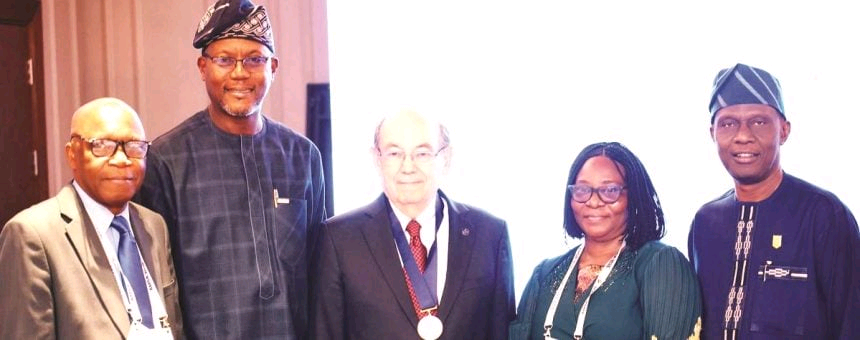

From left, President of AMSA, Professor Temidayo Ogundiran; President-Elect of the World Federation for Medical Education (WFME), Professor Oluwabunmi Olapade-Olaopa; WFME President, Ricardo Leon-Borquez; Professor Bernice Adegbehingbe; and Dr David Aturo during the investiture of Professor Olapade-Olaopa as the President-Elect of WFME, recently in Lagos.
Experts at the Association of Medical Schools in Africa (AMSA) Conference, held in partnership with the World Health Organization (Africa Region), have highlighted the crucial role of medical students in transforming health systems across the continent, calling for increased investment in research, innovation, and mentorship.
Speaking during a panel session titled “Training the Future, Strengthening the Present: Medical Students as Catalysts for Health Systems Strengthening in Africa,” Professor Rufus Akinyemi, a neurologist at the University of Ibadan, said health systems extend beyond hospitals and clinics to include the training of medical, dental, and public health professionals, all aimed at improving the quality of life of citizens.
He noted that medical students can play a significant role in addressing Africa’s healthcare challenges through research, advocacy, and digital health innovation. According to him, although Africa bears nearly a quarter of the global disease burden, it contributes only a small proportion to global research output.
Professor Akinyemi cited the Ibadan College Research Innovation Hall, established in 2019, as a model initiative that has supported over 240 students and produced about 70 academic publications, with participants also gaining fellowships and international research opportunities.
He called for similar programmes to be replicated across the continent to nurture a new generation of physician-scientists and innovators.
He further emphasised the importance of mentorship in developing future healthcare leaders, urging governments and philanthropic organisations to invest in research infrastructure and create enabling environments to retain young talent within Africa.
Also speaking, Professor Alfred Yawson, a public health expert, identified key challenges undermining Africa’s health systems, including workforce shortages, weak financing, and inequitable access to healthcare services.
He warned that the migration of skilled healthcare professionals to high-income countries continues to strain the continent’s limited workforce, particularly in specialised fields such as nursing, anaesthesia, and advanced clinical care.
Professor Yawson also described inadequate health financing as a major obstacle to achieving universal health coverage, stressing the need to ensure that cost does not prevent access to care.
While acknowledging ongoing efforts to expand training programmes, he cautioned that training alone is not enough without effective retention strategies. He called for stronger international collaboration and policy engagement, including at the level of the African Union, to address the ethical and economic implications of health worker migration.
He added that reforms in medical education should move beyond traditional classroom methods to incorporate soft skills such as entrepreneurship, digital literacy, and innovation, alongside a shift toward competency-based training.
In his remarks, student health advocate Victor Femi-Lawal urged medical students across Africa to harness research, advocacy, and collaboration to bridge gaps in healthcare delivery.
He noted that medical students, driven by passion and energy, are well positioned to contribute through community outreach, public health campaigns, and even policy engagement.
Femi-Lawal encouraged students to be intentional and proactive in seeking opportunities to strengthen health systems and improve outcomes across the continent.
Similarly, Dr Babatunde Abdulmalik highlighted the role of student-led organisations such as the Federation of African Medical Students’ Associations (FAMSA) and the International Federation of Medical Students’ Associations (IFMSA) in equipping young professionals with the skills and exposure needed to tackle Africa’s health challenges.
Drawing from his experience, he recalled participating in community outreach programmes as a medical student, including initiatives supporting underserved children, which helped shape his commitment to public health and problem-solving.
The experts collectively called for sustained investment, collaboration, and innovation to empower medical students as key drivers of stronger and more resilient health systems in Africa.
