



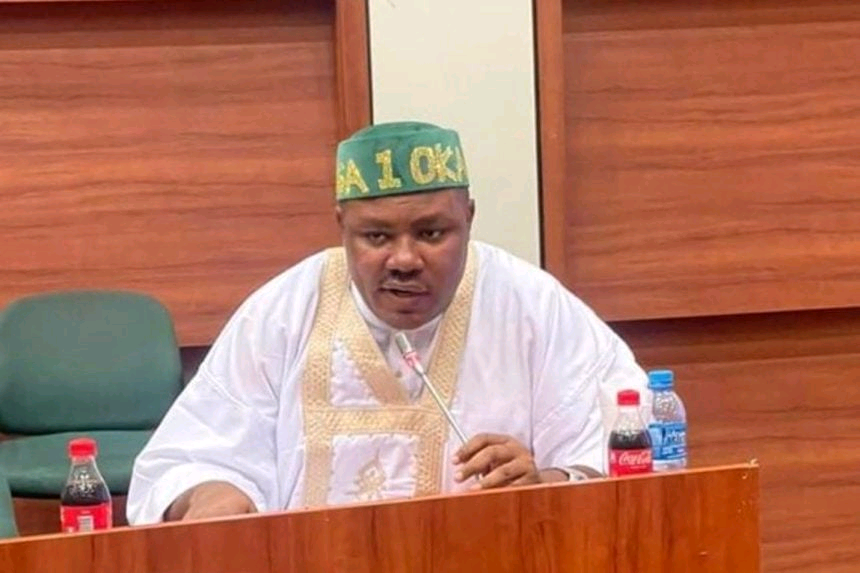

The Deputy Chairman of the House of Representatives Committee on Media and Public Affairs, Hon. Philip Agbese, on Sunday disclosed that leadership positions in Parliament are governed by established rules, conventions, party structures, and institutional procedures.
Hon. Agbese stated this in a rebuttal issued on Sunday amid ongoing controversy over the reported endorsement of Ugochinyere by 61 opposition lawmakers as their preferred candidate for the position of Minority Leader, following the resignation of Kingsley Chinda after his defection to the ruling APC.
The lawmaker, who represents Ado/Okpokwu/Ogbadibo Federal Constituency of Benue State, further observed that a segment of opposition lawmakers cannot alter or circumvent the Standing Rules of the 10th House of Representatives.
He maintained that claims suggesting Hon. Ugochinyere had emerged as Minority Leader were premature and inconsistent with parliamentary procedure.
He argued that the claim being advanced by supporters of Ugochinyere is based on the erroneous assumption that a numerical majority of opposition lawmakers can independently appoint a Minority Leader.
According to him, “the central flaw in the argument is the assumption that a simple numerical majority of members who describe themselves as ‘Minority members’ can independently appoint a Minority Leader.”
He maintained that Order 9 Rule 7 of the House Standing Orders does not create an elective office that can be filled through an informal caucus vote.
“Minority leadership is not equivalent to a constituency election where whoever obtains the highest votes automatically assumes office,” he said.
He further rejected claims that the endorsement process had already been concluded, insisting that no nomination becomes effective until it is formally recognised by the House.
“There is no completed process until the House recognises the nomination,” he stated.
Hon. Agbese added: “A letter signed by members does not automatically create a leadership office. Until the Speaker is satisfied that all procedural requirements have been met and formally announces the leadership to the House, no vacancy can be deemed filled.”
He also dismissed assertions that discussions on the matter could no longer take place once a nomination letter had been submitted.
“The assertion that no discussion can take place after submission of a letter is contrary to parliamentary practice. Legislative bodies routinely review, verify, reconsider, and clarify leadership nominations before recognition,” he said.
Addressing arguments that Hon. Ugochinyere’s years in the House automatically qualify him for the position, Hon. Agbese maintained that legislative leadership demands more than length of service.
“The Rules do not state that three years of service automatically qualifies a member for Minority Leader. Experience remains a matter of judgment by the caucus, party leadership, and the House,” he argued.
He added that parliamentary leadership involves “mastery of House rules and procedures, management of inter-party relations, coordination of legislative strategy, engagement with the Executive, representation of the caucus before the House leadership, and oversight of parliamentary business.”
Hon. Agbese also challenged comparisons being made between Ugochinyere’s aspiration and the emergence of former presiding officers such as Hon. Aminu Waziri Tambuwal, Hon. Yakubu Dogara, Senator Bukola Saraki, and Senator Ike Ekweremadu.
Describing such comparisons as misplaced, he noted that those offices were filled through constitutional elections conducted on the floor of the chambers, unlike the process for selecting a Minority Leader.
“The constitutional election of a Speaker is fundamentally different from the nomination and recognition of minority leadership,” he said.
On the issue of zoning and parliamentary conventions, Hon. Agbese argued that legislative institutions operate not only through written rules but also through established conventions and precedents.
“The argument that zoning does not exist because it is not expressly written ignores one of the most important features of parliamentary systems,” he noted.
According to him, “Parliaments operate not only through written rules but also through conventions, precedents, practices, and understandings.”
He cited regional balancing, party balancing, committee allocation, leadership distribution, and geopolitical representation as examples of convention-based parliamentary arrangements.
Hon. Agbese also rejected suggestions that securing the signatures of 61 lawmakers automatically settles the matter.
“Numbers alone do not determine parliamentary leadership. Parliamentary leadership requires legitimacy, procedural compliance, party acceptance, institutional recognition, and formal announcement. Numbers alone do not create an office,” he noted.
He warned that if mere numerical strength were enough to create parliamentary offices, “every caucus meeting would have the power to create leadership positions outside the rules.”
The Deputy Spokesman maintained that no lawmaker could legitimately claim the office of Minority Leader until the prescribed parliamentary process had been completed.
“The Rules contemplate a structured parliamentary process culminating in institutional recognition by the House. Until that process is completed, no individual can legitimately claim to have become Minority Leader.”
He added that the claim that the matter is concluded, beyond discussion, or immune from further consideration is inconsistent with parliamentary practice, legislative procedure, and the Rules of the House of Representatives, Hon. Agbese stressed.
